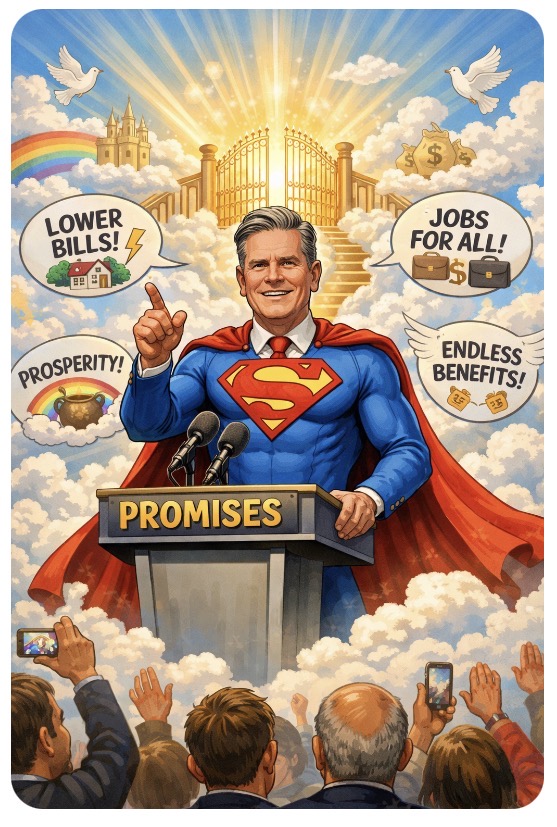
🦸♂️💸Every few months, Britain gets a familiar political blockbuster. The cameras click on, the lectern appears, and the Prime Minister strides forward like a caped crusader ready to protect the public from a looming economic villain. This time the role belongs to Keir Starmer, stepping onto the stage to reassure the nation that help is coming for households battered by energy bills and economic pressure.
Cue the heroic music. Government will intervene. Support is on the way. Britain will be shielded.
But if you pause the film for a second and zoom out from the dramatic lighting, the storyline begins to look… oddly circular. 🎬
🦸 The Government vs… The System It Runs
Energy prices surge because Britain’s energy market is tied to global oil and gas benchmarks like Brent Crude. When those prices spike, the shock spreads everywhere: transport costs climb, manufacturing gets pricier, electricity bills inflate, and households feel the squeeze.
None of this is news. Governments have known for decades how this system behaves.
Yet the same political ritual repeats every time prices rise. The system produces a crisis. Then the government appears like a superhero… to rescue the public from the consequences of that same system.
It’s a bit like a lifeguard who also secretly controls the tide. 🌊
The rescue typically arrives in the form of subsidies, price caps, rebates, or tax tweaks. On paper, that sounds compassionate. In practice, it produces one of the most peculiar loops in modern economics:
Taxpayers fund programmes that give money back to taxpayers.
The government borrows or reallocates public funds, distributes relief, and declares victory. But the money still originates from the public purse. The pain is eased today, and the bill politely waits for tomorrow.
And tomorrow, inconveniently, always arrives.
That’s where the quiet companion of every emergency announcement sneaks in: debt. Government borrowing pushes the cost up the hill. Eventually gravity does its job, and the financial rock rolls back down in the form of higher taxes, squeezed public services, or a fresh round of austerity.
Politically speaking, it’s perfect timing. The consequences often land on a completely different government. 🎯
Then there’s the curious case of fuel taxation. Britain already collects substantial revenue through fuel duty and VAT. Motorists have effectively been the Treasury’s most dependable ATM for decades.
But there’s a twist in the plot. The push toward electric vehicles will gradually erode that revenue stream. No petrol pump means no fuel duty. Which leaves policymakers with a dilemma worthy of a Treasury thriller:
Extract revenue from petrol and diesel while you still can… while quietly designing a new way to tax electric transport later.
Not exactly a heroic rescue arc. More of a fiscal juggling act. 🤹
And that’s where public frustration really begins to simmer.
The policies themselves aren’t necessarily the issue. Governments do need tools to soften economic shocks. The real irritation lies in the theatre. The speeches frame these interventions as bold, heroic solutions to sudden crises.
But the underlying machinery—the global energy market, the taxation structure, and the cycle of debt—remains largely untouched.
Different podium. Different speech. Same script.
Which leaves voters staring at the stage with an increasingly awkward question:
If the system creating the crisis never fundamentally changes… are these announcements actually solutions?
Or just the next episode in a very long-running political series? 📺
🔥 Challenges 🔥
Here’s the uncomfortable thought: are politicians genuinely solving problems, or simply managing the optics of them? If governments repeatedly “rescue” us from crises produced by the same economic structure, where does responsibility really sit?
Jump into the blog comments and tell us what you think. Is this necessary economic firefighting—or political theatre with better lighting? 💬🔥
👇 Comment, like, and share if this hit a nerve.
Sharp takes, brutal honesty, and clever sarcasm are all welcome.
The best comments will be featured in the next issue of the magazine. 📝


 Chameleon Magazine
Leave a comment