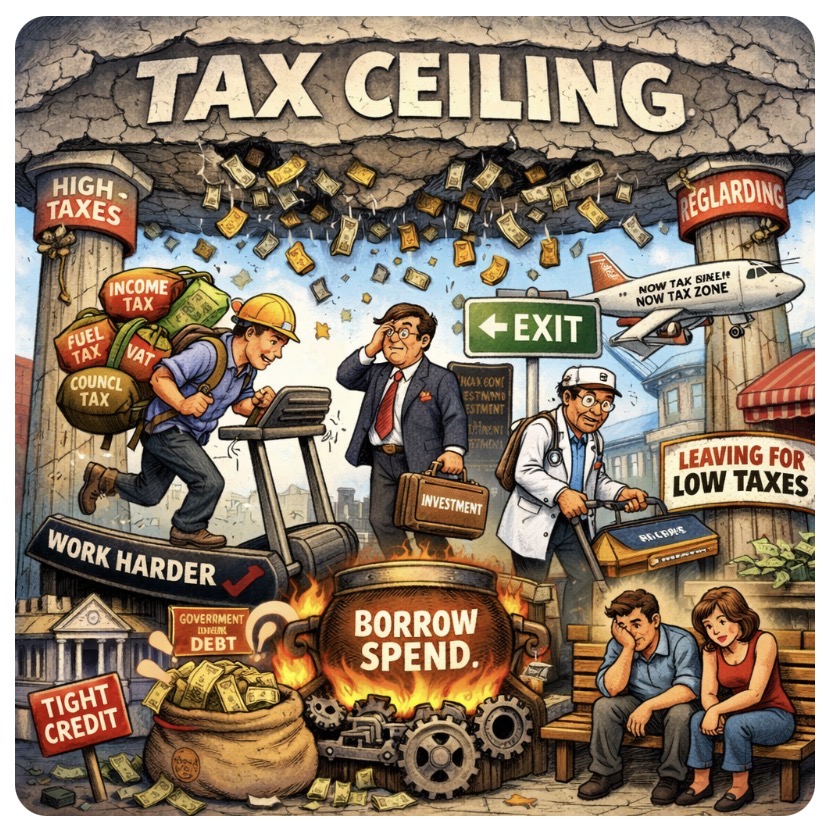
Every time the economy tightens, the ritual begins. A politician appears behind a podium, sleeves rolled, voice solemn, promising “support for working families” while assuring everyone that the government has everything under control.
But lurking behind the speeches is a question so politically radioactive it rarely gets spoken aloud:
What happens when a country hits the practical ceiling of taxation?
That uncomfortable moment when people begin to feel that working harder, investing more, or taking risks simply isn’t worth the shrinking reward.
Because the real tax burden isn’t just what shows up on your payslip. Not even close.
💷 The Great Disappearing Paycheck
Most people glance at their salary and see income tax. Maybe National Insurance. Annoying, yes—but manageable.
But the modern tax system doesn’t just take a slice once.
It slices again… and again… and again.
First comes income tax. Then National Insurance quietly rides shotgun like a second earnings tax.
Before your money even reaches your bank account, a substantial chunk has already been vacuumed away.
Then comes the second layer of taxation, the one people rarely calculate.
Spend your money? That’s Value Added Tax. Another 20% on most goods and services.
Fill your car? Fuel duty is baked into the price.
Buy a drink? Alcohol duty.
Take out insurance? Insurance premium tax.
Pay council tax? That’s another structural layer tied to simply existing in a property.
And let’s not forget the sneakiest passenger of them all: corporation tax, quietly folded into the price of almost everything businesses sell.
Individually, each tax seems tolerable.
Collectively, they form what economists call the tax wedge—the total share of economic value flowing from workers and businesses to the state.
And once all those layers are added together?
A striking portion of what people produce never actually stays in their hands.
🐌 When High Taxes Don’t Crash an Economy… They Just Slow It
Here’s the twist politicians rarely highlight.
High taxation usually doesn’t trigger dramatic revolutions or economic collapse.
Instead, something far more subtle happens.
People adjust their behaviour.
Economists track this through Taxable Income Elasticity—how people respond when taxes rise.
The reactions are rarely loud or immediate:
• A professional decides that chasing a promotion isn’t worth the extra tax.
• A business delays expansion because margins shrink.
• Investors move capital elsewhere.
• Highly skilled workers quietly relocate.
The economy doesn’t explode.
It gradually loses momentum.
Growth slows.
Governments then borrow more to keep spending levels steady.
🏗️ The Heavier Economy Problem
Modern economies are already carrying new structural weight.
After the financial crisis, regulations like Basel III made banks safer—but also far more cautious with lending.
Less lending means less private credit entering the economy.
So governments increasingly step in by borrowing through instruments like government bonds to keep the system moving.
The result?
A slowly evolving economic structure:
• Higher taxes
• Higher public debt
• More government intervention
• Slower organic growth
It’s not collapse.
It’s drift.
🔥 Challenges 🔥
Here’s the uncomfortable question nobody at the podium wants to answer:
At what point does the system stop rewarding effort?
When half the value of work disappears through layers of taxation, regulation, and embedded costs, people begin to wonder whether pushing harder actually changes anything.
And that’s the real danger—not riots, not revolutions.
Just millions of quiet decisions to stop trying quite so hard.


 Chameleon Magazine
Leave a comment