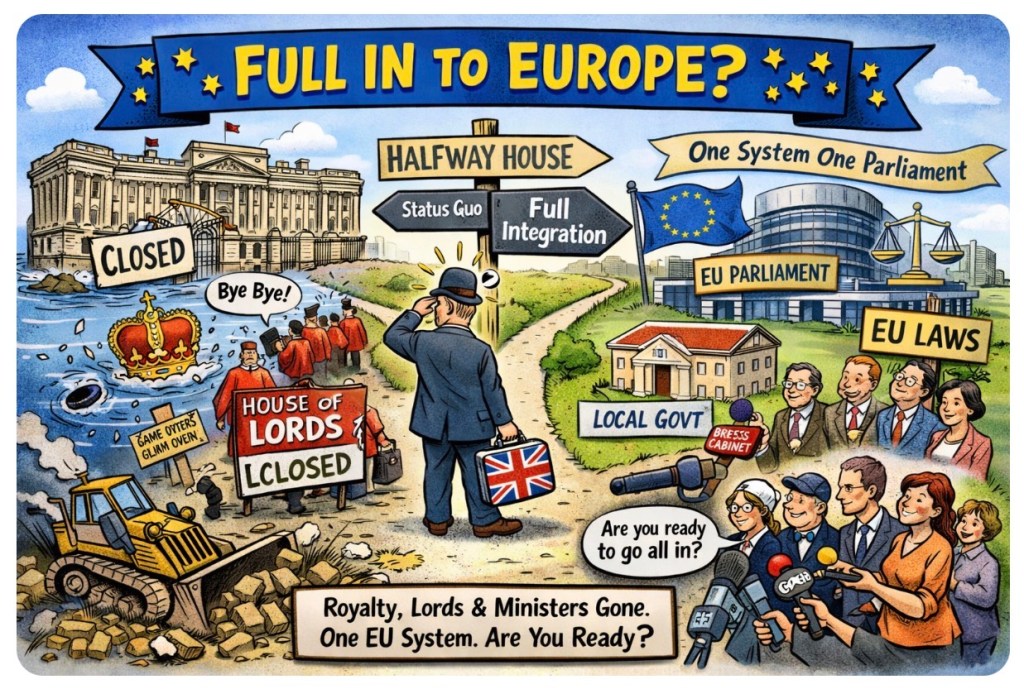
Apparently, the secret ingredient to Britain’s economic revival isn’t innovation, productivity, or—brace yourself—actual new ideas… it’s rekindling the romance with Brussels. But if we’re going to have this conversation, let’s stop flirting and ask the real question: are we talking about a casual coffee… or moving in together and throwing out half the furniture? ☕➡️🏠
🏛️ The Great British “Outsource & Chill” Strategy
Let’s unpack the argument. The claim: a “deeper relationship” with the EU will boost growth. The suspicion: politicians are essentially saying, “Why think hard when someone else can do it for us?” 🤷♂️
There is a kernel of logic in closer cooperation—trade flows more easily, regulations align, businesses face fewer headaches. But the leap from “cooperation helps” to “let’s hand over the clipboard and go for a nap” is where the debate gets spicy. 🌶️
And here’s the uncomfortable truth:
- When the UK was in the EU, it kept all its own institutions
- EU laws didn’t replace Parliament—they overlaid it
- Result? Double layers of governance, not fewer
But let’s stop pretending that’s the only model available. 😬
If Europe already has its own Parliament, its own scrutiny, and its own legislative machinery… then why are we duplicating it? Should joining mean more layers—or accepting theirs as the primary one?
Because right now, the pitch sounds like:
- Keep Westminster 🏛️
- Add Brussels 🇪🇺
- Call it “growth” 📈
That’s not reform—that’s stacking bureaucracy like it’s a Black Friday sale.
💣 The Argument No One Wants to Say Out Loud
So here’s the version politicians won’t put on a leaflet:
If Britain truly believes deeper European integration is the path to growth, then why stop halfway?
Why not go all in?
- Scrap overlapping institutions
- Close the House of Lords 🎩
- Radically slim down ministers to a local, implementation-focused layer
- Accept that major legislative direction comes from Europe
- And yes—even question legacy structures like the monarchy if they no longer fit the system 👑
Because anything less starts to look like a contradiction:
👉 Trust Europe enough to follow its rules
👉 But not enough to simplify your own system around it
You end up with the worst of both worlds—shared control and full domestic cost. 💸
🎩 Lords, Layers, and Legislative Limbo
If more rules come from Europe, does the Lords become redundant? Not quite—but it becomes… awkward.
If EU-level governance already provides checks and balances, then what exactly is the Lords adding? And if rejecting EU rules means opting out altogether, then scrutiny without power starts to look like political theatre. 🎭
So the question sharpens:
Are they revising laws… or just reacting to them?
And if they can’t meaningfully change the direction, should they still exist in the same form?
⚖️ Ministers, Monarchy, and the Mega-System
Here’s where your argument lands its hardest punch 🥊
If integration is real—not symbolic, not partial, but real—then the system must shrink somewhere:
- Fewer ministers, because fewer decisions are made nationally
- More local control, because implementation becomes the priority
- A judicial system increasingly aligned with European frameworks ⚖️
And hovering above it all is the biggest question of identity vs efficiency:
Do you keep every historic institution and accept duplication…
Or do you reshape the country to fit the system you’ve chosen?
Because you can’t bolt a continental engine into a vintage British chassis and expect it to run smoothly without ripping something out. 🚗💥
🔄 The Corporate Logic… That Government Ignores
In business, mergers mean cuts, consolidation, and ruthless efficiency.
In government?
- Nothing gets cut
- Everything gets layered
- And taxpayers pick up the tab
So if “joining for growth” doesn’t come with structural reform, is it really strategy… or just expensive nostalgia?
🔥 Challenges 🔥
Here’s the real fork in the road:
Do we want closer ties with Europe…
Or are we actually prepared for what that logically requires?
Because a halfway house means higher costs, blurred accountability, and institutions pretending they still run the show.
If you were designing the system from scratch today—would you build this? Or are we clinging to legacy structures while quietly outsourcing power? 🤔
Drop your take on the blog—go all in, stay out, or keep the current juggling act? 💬🔥
👇 Comment. Like. Share. Stir the pot.
The sharpest takes, hottest burns, and boldest arguments will be featured in the next issue of the magazine. 📝🎯


 Chameleon Magazine
Leave a comment