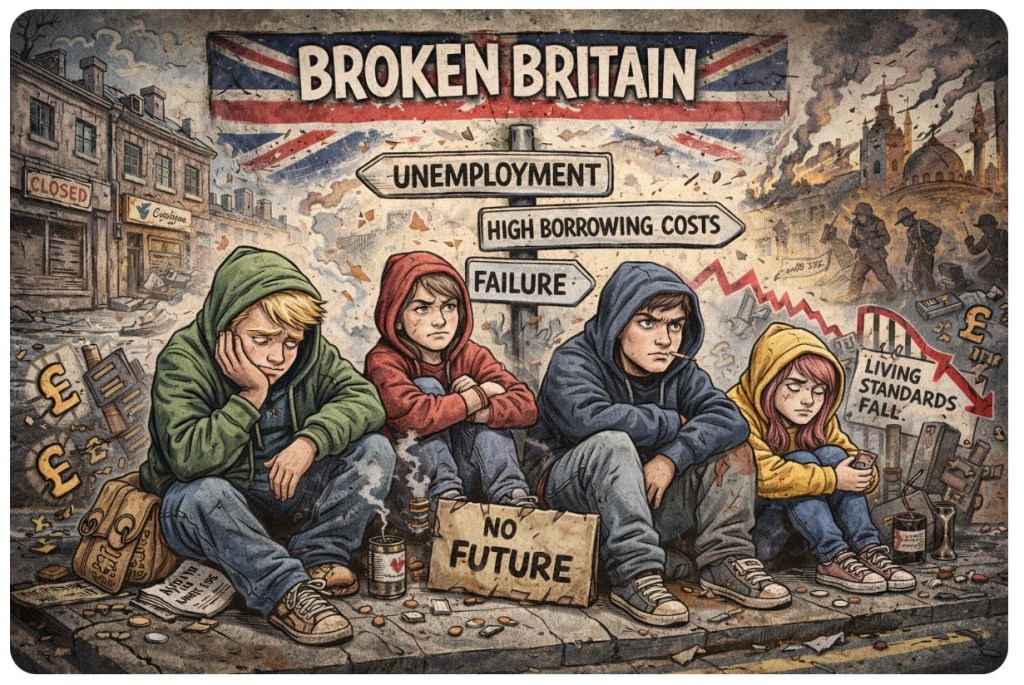
From pandemics to wars, the UK has had no shortage of excuses. But here’s the uncomfortable truth: while global chaos may have shaken the economy, it didn’t break it. That job? Largely homegrown.
With youth unemployment climbing to 16.1%—the highest in a decade—and borrowing costs spiralling like a bad habit, Britain isn’t just weathering storms… it’s leaking from the inside.
🌍 Blame the World… or Look in the Mirror?
Yes, the pandemic hit hard. Yes, global conflicts rattled markets. But here’s the pattern: every crisis gets blamed, every failure gets outsourced, and every policy mistake quietly slips under the radar. 🎯
Because if external shocks were the whole story, other countries would be sinking at the same speed. They’re not.
So what’s different here?
A cocktail of decisions that, on their own, looked manageable… but together? Toxic. ☠️
📉 The Youth Crisis No One Wants to Own
16.1% youth unemployment isn’t just a statistic—it’s a warning siren. 🚨
That’s a generation:
- Struggling to find work
- Delayed in building careers
- Locked out of stability before they’ve even started
And when young people stall, the entire economy slows with them. Less spending, less growth, less future.
But instead of urgency, we get… silence.
Because fixing youth unemployment requires long-term thinking—skills, education, industry—and that doesn’t fit neatly into election cycles. 🗳️
💸 Borrowing, Bills, and the Squeeze
At the same time, borrowing costs are climbing. Fast.
For households, that means:
- Higher mortgage payments 🏠
- Less disposable income 💳
- More pressure, everywhere
For government, it means less room to manoeuvre—and more temptation to patch holes instead of fixing foundations.
And so the cycle continues:
Short-term fixes → Long-term damage → Repeat. 🔄
🧠 The Real Problem: Policy Paralysis
Here’s the brutal takeaway:
It’s not one bad decision—it’s the combination.
- Weak growth strategy
- Poor productivity
- Rising costs
- Stalled opportunities
Individually survivable. Together? A slow grind downward.
And the most dangerous part? It doesn’t look like a crash. It looks like normality.
Living standards don’t collapse overnight—they quietly erode until people realise they’re working harder for less.
🇬🇧 The Illusion of Stability
Britain isn’t in freefall. It’s something worse:
Stuck.
Not broken enough to force radical change…
Not strong enough to deliver real progress…
Just hovering in a kind of economic limbo where decline feels gradual—and therefore acceptable.
🔥 Challenges 🔥
So here’s the real question:
Are global crises really to blame—or have they just been the perfect cover for years of bad decisions?
If nothing changes, are we looking at recovery… or managed decline dressed up as resilience?
Drop your take on the blog—what’s really holding Britain back, and who should own it? 💬🔥
👇 Comment. Like. Share. Call it out or call it nonsense.
The sharpest insights, boldest takes, and most brutal truths will be featured in the next issue of the magazine. 📝🎯


 Chameleon Magazine
Leave a comment