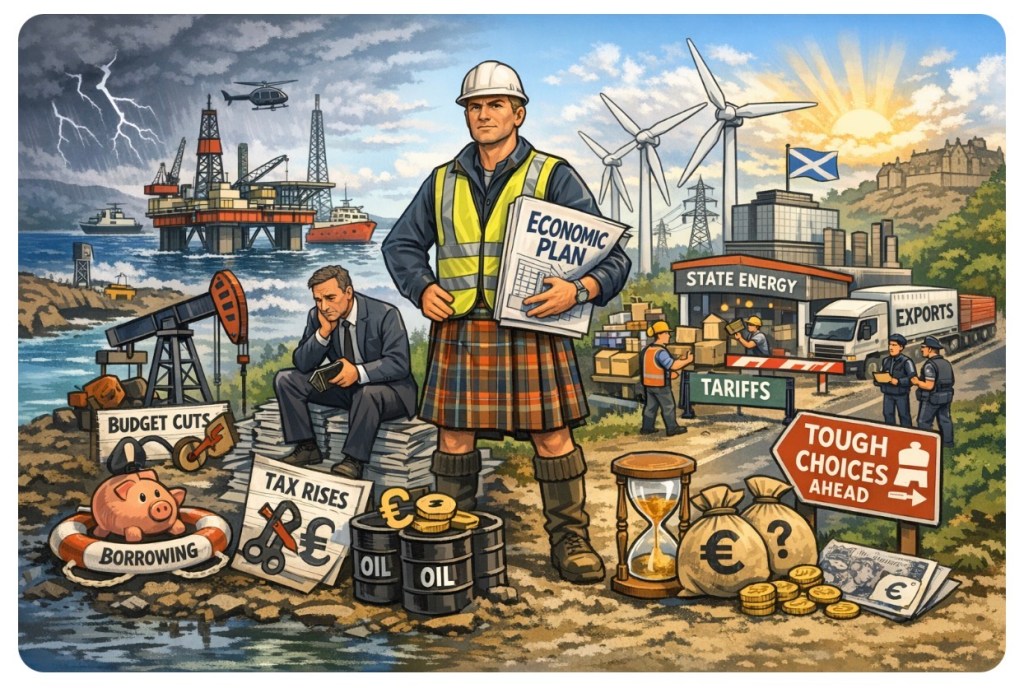
🏴💸⚡Everyone loves the idea of independence — flags waving, decisions made at home, destiny reclaimed. But here’s the inconvenient truth: independence isn’t a vibe, it’s a balance sheet with teeth. And right now, that balance sheet is staring Scotland down with a multi-billion-pound question.
So what would Scotland actually have to do — not dream, not promise, but do — to make independence economically viable?
🔧 The “Nice Idea” Meets the Cold Start Reality
Let’s drop the slogans.
Day one of independence would likely mean:
- A large fiscal deficit (north of £20bn)
- No automatic UK fiscal transfers
- Immediate pressure from markets, investors, and currency questions
👉 Translation: you don’t ease into independence — you hit the ground negotiating with reality.
💰 Step 1: Close the Gap (Or At Least Stop It Bleeding)
There are only three levers in economics:
- Tax more 💸
- Spend less ✂️
- Grow faster 📈
Scotland would almost certainly need all three.
That could mean:
- Higher taxes (income, corporate, or both)
- Slower growth in public spending
- Tough decisions on what gets protected (NHS?) and what gets squeezed
No politician wants to say it — but someone would have to.
⚡ Step 2: Build an Energy Strategy That Actually Pays
This is where Scotland has real leverage — but it needs to be done properly.
Not:
❌ “Wind will save us”
But:
✅ A full system:
- Public stakes in wind projects
- Smarter taxation of energy profits
- Investment in grid, storage, and export capacity
- Long-term planning (not quick cash grabs)
👉 The goal: stop exporting energy wealth and start capturing it
But be clear:
This takes years, not months.
🛢️ Step 3: Use Oil — But Don’t Bet the Country on It
Oil can help — but it’s no longer the golden ticket.
A realistic approach would be:
- Encourage continued production
- Tax fairly (without scaring off investment)
- Use revenues as a bridge, not a foundation
👉 Oil = support act, not headline act.
💱 Step 4: Solve the Currency Question (The Elephant in the Room)
You cannot run a country without answering:
👉 What money are we using?
Options:
- Keep the pound (limited control)
- Create a new currency (risky early years)
- Join the euro eventually (long-term path)
Each comes with trade-offs:
- Interest rates
- Mortgage costs
- Investor confidence
👉 This is the single biggest credibility test
🚢 Step 5: Protect Trade — Especially With the Rest of the UK
Right now:
- ~60% of Scotland’s exports go to the rest of the UK
So independence must answer:
👉 How do you avoid barriers with your biggest customer?
Because even small friction:
- Hits businesses
- Shrinks tax revenue
- Makes the deficit worse
🧠 Step 6: Be Honest About the Transition
This is the part missing from most debates.
A credible plan would say:
- The first few years may be economically tight
- There may be:
- Higher taxes
- Spending restraint
- Slower growth
👉 But with a long-term payoff of control and restructuring
Without that honesty:
❌ It sounds like fantasy
❌ Markets won’t buy it
❌ Voters eventually won’t either
🧨 The Real Story (No Spin, No Slogans)
Independence is not impossible.
But it is:
👉 A high-risk, high-control economic reset
And the winning case isn’t:
❌ “We’ll be richer immediately”
It’s:
👉 “We take a hit early to build something different later.”
🔥 Challenges 🔥
Be honest — would you accept higher taxes or tighter spending for 5–10 years if it meant full economic control after that? Or does the risk outweigh the reward?
Drop your take in the blog comments — not just social media. We want the real opinions, not the safe ones. 💬🔥
👇 Comment, like, share — and don’t hold back.
The sharpest takes will be featured in the magazine. 🎯📝


 Chameleon Magazine
Leave a comment