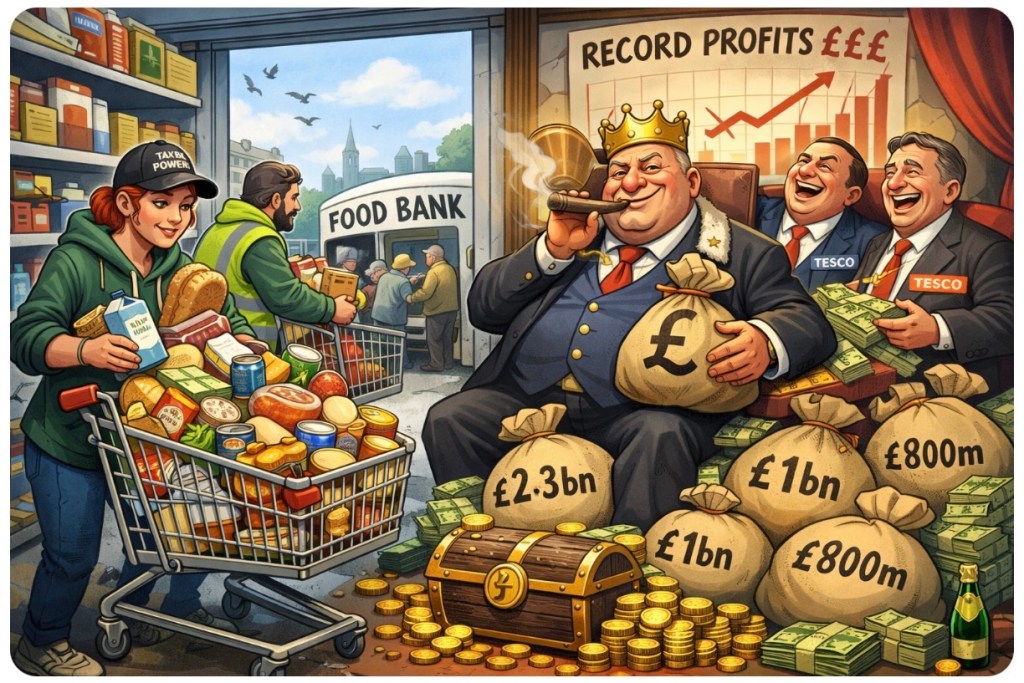
🛒🏹💷Yes — the story is real, but not exactly “today.” Over the weekend of 14 March 2026, activists from Take Back Power entered supermarkets across the UK and removed food, claiming they were redistributing it to food banks. A bold move? Sure. Legal? Questionable. Symbolic? Oh, absolutely — especially when you zoom out and look at the eye-watering profits sitting behind those automatic doors.
Because here’s where the plot thickens like budget gravy…
💰 The “Hungry Nation” Meets the Billionaire Breadbasket
While food banks stretch tins like Olympic athletes, the UK’s biggest supermarkets have been quietly stacking profits that would make even Robin Hood pause mid-arrow:
- Tesco: ~£2.3–£2.8 billion annual profit 💸
- Sainsbury’s: ~£700 million–£1 billion 🍞
- Asda: ~£1 billion (varies, privately owned but similar ballpark) 🏬
- Morrisons: ~£800 million–£1 billion 🥩
That’s not revenue — that’s profit. After costs. After wages. After the “Clubcard savings” confetti has settled.
Now, before anyone starts foaming at the barcode scanner, supermarkets will argue (not incorrectly) that margins are actually quite tight compared to other industries — usually just a few percent. But when you’re dealing in tens of billions in sales, even a “small” slice becomes a very large pie 🥧.
So when activists wheel out unpaid groceries and call it “redistribution,” they’re not just staging a stunt — they’re pointing directly at a system where corporate survival is stable, but household survival isn’t.
🦹♂️ Capes Optional, Optics Mandatory
Is this Robin Hood behaviour? Let’s be honest — it’s more high-vis vest meets moral philosophy than medieval folklore. There are no bows, no arrows, just fluorescent lighting and a security guard wondering how this ended up on their shift.
But the symbolism hits harder when you factor in those profits. It reframes the act from “random shoplifting” to something more politically charged: a challenge, however clumsy, to the idea that food scarcity exists alongside corporate abundance.
Still, the uncomfortable truth remains:
This isn’t stealing from a king — it’s taking from a system that also feeds millions of ordinary people every day.
So the question isn’t just “is this right?”
It’s “what kind of country makes this argument feel plausible in the first place?”
🔥 Challenges 🔥
Here’s your dilemma: if supermarkets are making billions while food banks are booming, where exactly does “fairness” sit on the shelf? Between the reduced stickers and the security cameras?
Is this activism… or just outrage with a trolley?
💬 Don’t just scroll — drop your take in the blog comments. We want your verdict: heroic, hypocritical, or something messier in between.
👇 Like it, share it, argue about it — loudly.
The sharpest, funniest, and most brutally honest comments will be featured in the magazine. 🎯📝


 Chameleon Magazine
Leave a comment