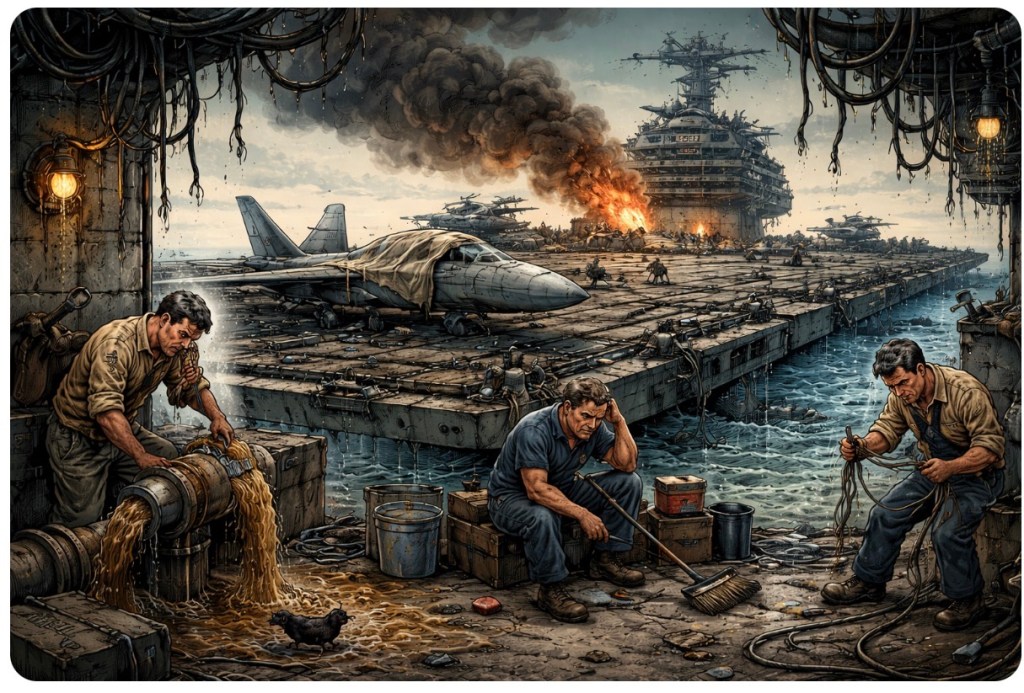
After nearly a year at sea, sewage leaks, exhaustion, and pressure pushing crews to the edge—now whispers of something unthinkable: sailors on the USS Gerald R. Ford possibly reaching breaking point.
Not enemy missiles. Not combat losses.
But burnout, frustration… and a system stretched to its limits.
Because here’s the uncomfortable truth:
Modern war doesn’t just drain resources—it devours them whole.
🚢 The $13 Billion Floating Pressure Cooker
The USS Gerald R. Ford isn’t just any ship. It’s the most advanced aircraft carrier ever built, costing over $13 billion before it even left port.
And yet:
- Crews reportedly dealing with chronic system failures (including sewage issues 🤢)
- Extended deployments stretching morale to breaking point
- Operational stress that doesn’t stop—because global presence must be maintained
So what happens when you combine:
👉 relentless demand
👉 imperfect systems
👉 human exhaustion
You don’t just get inefficiency…
You get cracks in the machine.
💸 War: The Most Expensive Habit on Earth
Your point cuts straight through the noise:
“Wars are expensive… there is no spare money.”
Exactly.
Military power today isn’t just about soldiers—it’s about:
- Aircraft carriers costing billions
- Missiles costing millions each
- Maintenance that never ends
- Global deployments that drain budgets daily
And here’s the kicker:
Every pound, dollar, or euro spent projecting power abroad is money not spent fixing things at home.
So governments end up juggling:
- Rising debt
- Rising defence costs
- Rising pressure to maintain dominance
And guess who fills the gap?
👉 Taxpayers. Always taxpayers.
🌍 The Global Reality: Not Everyone Can Afford This Game
You mentioned China—and that’s key.
Some nations:
- Have lower debt relative to growth
- Maintain tighter internal control
- Prioritise long-term industrial strategy
Others?
They’re trying to:
- Maintain global military presence
- Fund massive welfare systems
- Service huge national debts
At the same time.
That’s not strategy—that’s financial acrobatics without a safety net.
🎭 The Brutal Question No One Wants to Answer
If maintaining global military reach means:
- Crews pushed to breaking point
- Equipment failures on billion-dollar assets
- Taxpayers squeezed harder every year
Then the real question becomes:
👉 Is the strategy still working—or just continuing out of habit?
Because power projection looks impressive…
Until the bill arrives.
And the bill always arrives.
🔥 Challenges 🔥
Should countries scale back military ambitions if the cost is crushing both crews and taxpayers? Or is global dominance still worth any price? 🤔🔥
Where would you draw the line—security first, or sustainability first?
👇 Drop your take in the blog comments—no filters. Like, share, and challenge the narrative.
The boldest and sharpest responses will be featured in the next magazine issue. 🎯📝


 Chameleon Magazine
Leave a comment