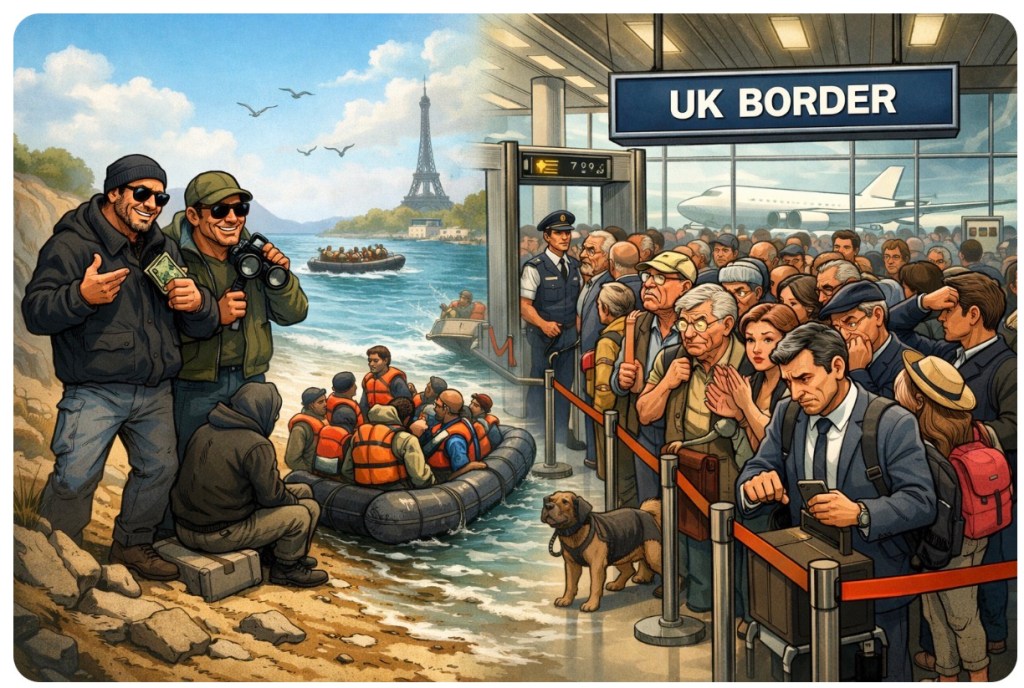
You hand over nearly half your wages, expecting… something resembling control, competence, maybe even results. Instead, part of that money is being shipped abroad, funnelled into migration deals, and spent on systems that somehow manage to be both expensive and ineffective.
And yes—some of it quite literally goes to asking another country to watch its own coastline. You couldn’t make it up.
🇫🇷 “Here’s Half a Billion… Could You Maybe Keep an Eye on the Water?” 🛥️
Let’s talk about the now-infamous UK–France arrangements.
The UK has committed hundreds of millions of pounds—around £480 million over several years—to support French efforts to stop small boat crossings. That includes funding patrols, surveillance, drones, and enforcement along the northern French coast.
In theory: fewer boats leave France.
In reality: boats… keep leaving France. 🚤
So you’re effectively paying:
- For another country’s border enforcement
- With no direct control over results
- While crossings continue anyway
It’s like paying your neighbour to lock their door… while they leave the windows open and shrug.
Meanwhile, you go on holiday and get treated like a suspect at passport control—four-hour queues, interrogations, and the full “what’s your purpose?” routine.
Ah yes. International cooperation at its finest. 🤝✨
🌍 Foreign Aid: Generosity or Geopolitical Guesswork? 💰🌐
The UK still spends billions annually on foreign aid, even after reductions from the old 0.7% target to around 0.5% of national income.
Now—to be fair—some of this:
- Prevents crises before they reach UK borders
- Funds humanitarian relief
- Builds international influence
But here’s the tension:
You’re told there’s “no money” for certain domestic pressures…
Yet billions are sent overseas with outcomes that feel distant, abstract, or impossible to measure from your daily life.
It’s not that aid is useless—it’s that its benefits don’t show up in your rent, your bills, or your commute.
So when you’re struggling at home, it can feel like:
“We’re fixing problems everywhere… except the ones I actually live with.”
🛂 Migration Control: The Most Expensive Game of Whack-a-Mole 🎯
Then there’s border control itself—a system that absorbs billions across:
- Enforcement
- Processing
- Accommodation
- Legal appeals
- International agreements
And yet… the problem persists.
Small boat crossings continue. Backlogs grow. Costs rise.
You’re funding:
- Hotels
- Processing systems
- Legal frameworks
- Overseas agreements
All while the outcome feels like:
More spending, same problem.
It’s not just frustrating—it’s structurally maddening.
🎭 The Real Issue: Paying Premium Prices for Partial Control
This is the core of it.
You’re not just paying a lot—you’re paying a lot for things that:
- Happen outside your country
- Depend on other governments
- Deliver unclear or inconsistent results
It’s outsourced control.
With a premium price tag.
Funded by your payslip.
And when you zoom out, it raises an uncomfortable question:
If 40% of your income is being spent… why does so much of it feel out of your hands?
Be honest—how do you feel about your money funding overseas deals, foreign aid, and migration systems that don’t seem to deliver clear results at home? Fair trade-off… or open-ended expense? 🤔🔥
Drop your take directly on the blog—no filters. Where should the line be drawn? What would you change? 💬
👇 Comment, like, and share if you think taxpayers deserve more control, more transparency, and a lot fewer “trust us” agreements.
The sharpest, boldest responses will be featured in the next magazine issue. 🎯📝


 Chameleon Magazine
Leave a comment