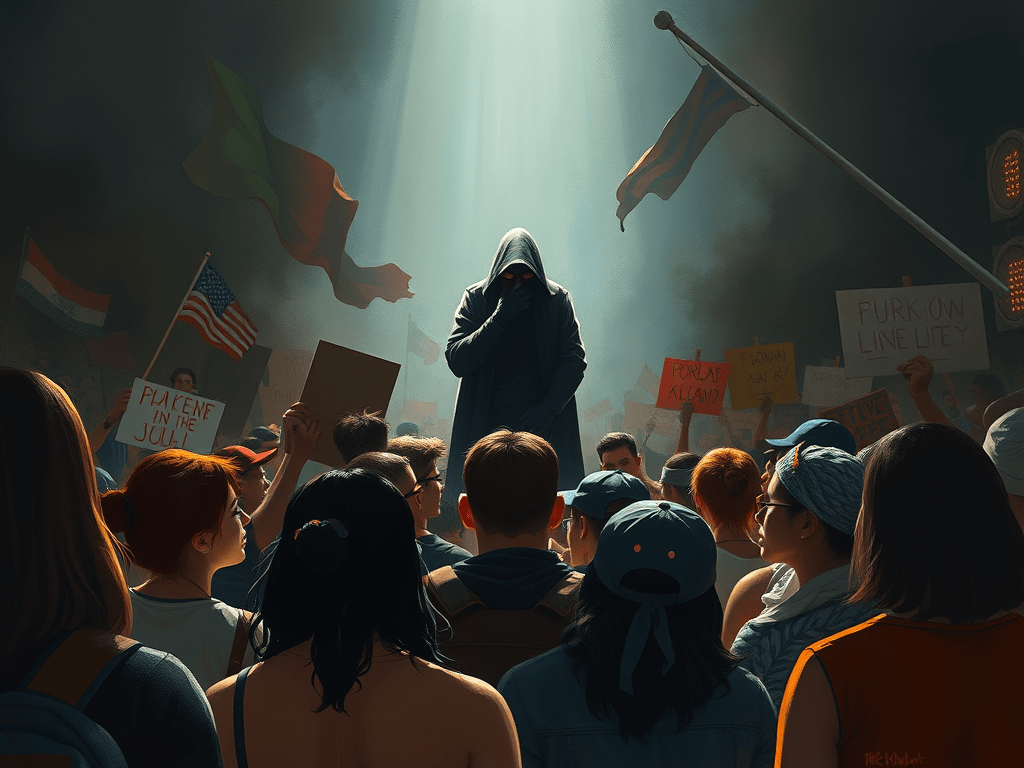
⚠️🔥There’s a moment—easy to miss if you’re not looking for it—when protest stops being about expression and starts becoming something heavier. Something sharper. It’s no longer about voices being heard; it’s about making others feel like they shouldn’t be heard at all.
And once that shift happens, everything changes.
Because targeting a community—through fear, through threats, through actions that make people look over their shoulder—isn’t protest. It’s intimidation dressed up in the language of justice. It’s the point where principle quietly exits the room and something far uglier takes its place.
🚨 When the Line Is Crossed, It Doesn’t Whisper — It Shouts
We like to pretend these moments are complicated. That they require nuance, long debates, panels of experts carefully unpacking “context.”
But the truth is far less comfortable.
The line isn’t subtle. It doesn’t hide. It announces itself loudly—when a synagogue needs protection not as a precaution but as a necessity… when emergency services tied to a community become targets… when people start calculating whether it’s safe to be visibly who they are.
That’s not political expression anymore. That’s pressure. That’s fear being used as a tool.
And calling it anything softer doesn’t make it less real—it just makes the response weaker.
⚖️ The Problem Isn’t a Lack of Power — It’s a Lack of Nerve
Here’s the part no one really wants to say out loud: the system already knows what to do.
There are laws. There are processes. There are clear lines that have been written, debated, and agreed upon long before this moment arrived.
But instead of action, we get hesitation. Careful wording. A kind of institutional tiptoeing, as if acting decisively might somehow make things worse.
It doesn’t.
What makes things worse is delay. Because every moment where nothing happens doesn’t feel like restraint—it feels like permission.
And people notice.
They always notice.
🎭 The Theatre of Leadership
Then come the statements. Carefully crafted, delicately balanced, designed to offend absolutely no one—and in doing so, reassure absolutely no one either.
You’ve heard them before. Everyone has.
A condemnation that somehow sounds unsure of itself. A call for calm that lands like background noise. A message so polished it slides straight past the reality people are actually living.
But this isn’t a situation that needs polish. It needs clarity.
Because when something is wrong—clearly, undeniably wrong—saying it plainly isn’t divisive. It’s necessary.
And when leaders can’t bring themselves to do that, people don’t see diplomacy.
They see hesitation. Or worse… avoidance.
🔁 What Happens When Standards Start to Shift
The real damage doesn’t just come from what’s happening—it comes from how unevenly it’s handled.
If rules feel flexible depending on who’s involved, trust doesn’t bend. It breaks.
People start to wonder why some actions are met with swift consequences while others seem to drift through a fog of “understanding.” That question lingers. It grows. And eventually, it turns into something far harder to manage than the original problem.
Because once fairness is questioned, everything else follows.
👁️ What People Actually Need to See
Words are easy. They always have been.
But people aren’t looking for words right now—they’re looking for proof.
Proof that the line still exists.
Proof that crossing it still matters.
Proof that the system doesn’t just react when it’s convenient, but when it’s necessary.
Without that, something else takes hold. Not just frustration, but a quiet, creeping sense that the rules are becoming optional.
And that’s when things really start to unravel.
🔥 Challenges 🔥
At what point does “we’re monitoring the situation” start to sound like “we’re letting it happen”?
How many times can the same line be crossed before people stop believing it exists at all? And here’s the harder one—if it were your community feeling the pressure, would patience still feel like the right response?
Don’t just agree. Don’t just scroll. Challenge this. Tear it apart or back it fully—but do it where it counts. Drop your thoughts directly on the blog. 💬🔥
👇 Hit comment, hit like, hit share. Say what others are thinking but not typing.
The most powerful, sharpest, and realest responses will be featured in the next issue of the magazine. 🎯📝


 Chameleon Magazine
Leave a comment