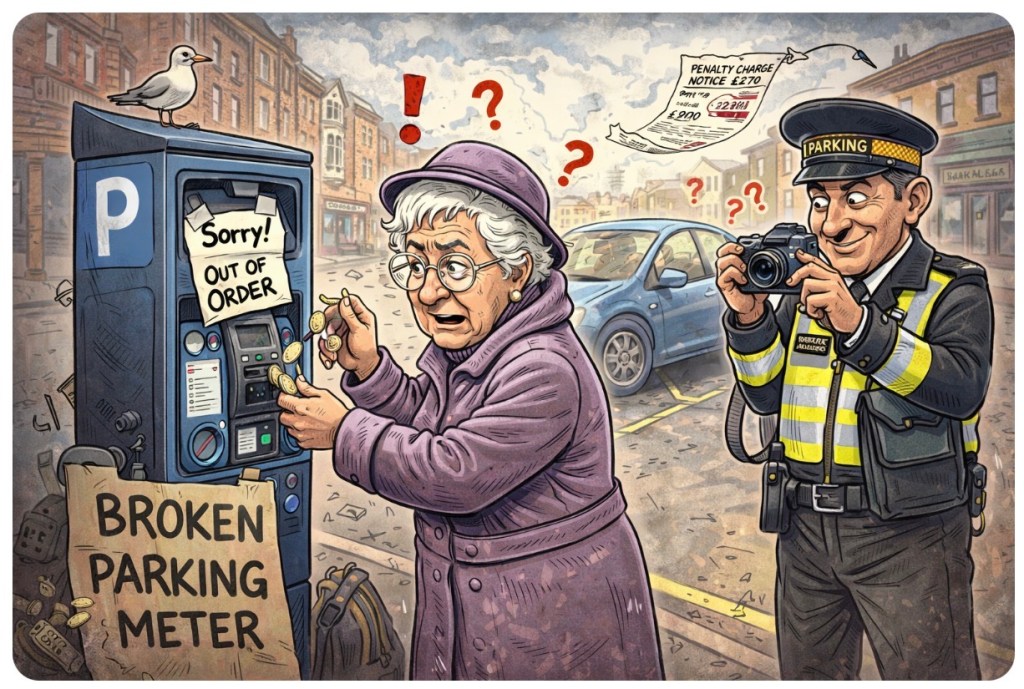
An 81-year-old woman tries to pay for parking. The machine doesn’t work. The system shrugs. And somehow—somehow—the only thing functioning flawlessly is the £270 fine that drops through her letterbox like a bureaucratic punchline.
Welcome to modern Britain, where the parking meter is optional… but the penalty is mandatory. 🧾⚠️
🧍♀️ From Street Scammers to System Scams: The Uniform Upgrade 😑
There was a time when scams came from dodgy emails, fake calls, and blokes in hoodies asking for your bank details.
Now? The demand comes stamped, official, and backed by enforcement.
Let’s call it what it feels like to the person on the receiving end:
- You try to pay
- The system fails
- You get fined anyway
- And then you’re told you have to prove your innocence
That’s not just frustrating—that’s structurally one-sided.
Because traditional scams rely on confusion and pressure.
This? It adds authority and automation to the mix.
No need to trick you—just issue the fine and let the system do the rest. 💻💸
And here’s the uncomfortable bit:
When councils operate systems where failure still results in penalties, and appeals feel like shouting into a void, it starts to blur the line between enforcement and extraction.
Not criminal in the legal sense—but to many people, it carries the same energy:
- You’re cornered
- You’re outmatched
- And paying up feels easier than fighting
That’s why the word “scam” keeps creeping into conversations. Not because councils are literally criminal gangs—but because the experience feels eerily similar.
🤖 Efficiency for Fines, Malfunctions for Everything Else
What’s remarkable isn’t that the machine broke—it’s that nothing in the system pauses when it does.
- No automatic grace period
- No “machine reported faulty” override
- No presumption of good faith
Just: fine issued, now you deal with it.
And suddenly the burden flips entirely onto the public, including—apparently—an 81-year-old expected to document a broken meter like a forensic investigator. 🕵️♀️
🔥 Challenges 🔥
When did public service start feeling like a trap? If a system can fail you but still punish you, is that enforcement—or something else entirely?
Have you ever paid a fine you knew was wrong just to avoid the hassle? Drop your story in the blog comments—we want the real experiences, not the polished PR version. 💬🚗
👇 Like, comment, and share if you think accountability should work both ways.
The best stories (and sharpest takes) will be featured in the next issue. 🎯📝


 Chameleon Magazine
Leave a comment