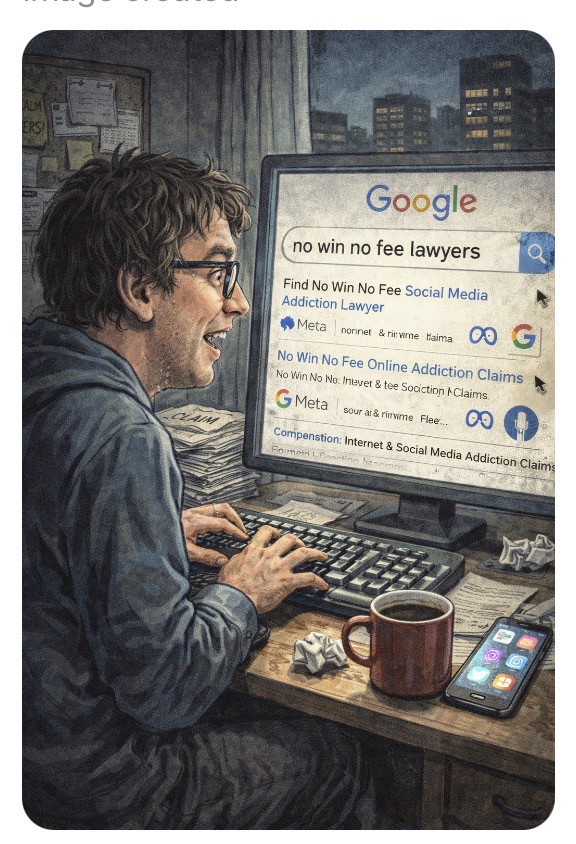
A courtroom bombshell lands as tech giants Meta and Google are blamed for “rewiring” a user’s brain through social media addiction—and suddenly, the nation’s thumbs pause mid-scroll. Not to log off… but to search: “How much can I get?” 💸
⚖️ From Doomscrolling to Courtroom Drama
So let’s get this straight: years of endless scrolling, dopamine hits, algorithmic rabbit holes… and now it turns out your late-night Instagram spiral might not just cost sleep—it might pay out.
Naturally, the UK public reaction can be summarised in three steps:
- Shock 😮
- Validation 😌
- “Where do I sign?” 📝💷
Because if one person can win a case arguing their brain was turned into a notification-addicted mush machine, then suddenly half the country is side-eyeing their screen time report like it’s evidence in a class action lawsuit.
And you just know what’s coming next…
Search engines (ironically) lighting up with:
- “No win no fee social media addiction claim”
- “Can I sue for TikTok ruining my attention span?”
- “Compensation for scrolling past midnight since 2012”
The modern gold rush isn’t in oil or property—it’s in plaintiffs. 🏃♂️💼
Meanwhile, Silicon Valley’s finest are likely preparing their defence:
“Your Honour, we didn’t force them to scroll… we just made it psychologically irresistible.”
Which, admittedly, isn’t the strongest look.
But here’s the twist—if courts start siding with users, we could be looking at:
- A tidal wave of claims 🌊
- A legal industry boom 💼
- And terms & conditions longer than a Tolstoy novel 📚
All because the infinite scroll turned out to be… infinitely litigable.
🔥 Challenges 🔥
So where do you land?
Are these platforms genuinely engineered to hook users—or is this just the ultimate case of blaming the app for your own screen habits? 🤔
And if compensation is on the table… who doesn’t think they’ve got a claim?
Drop your take directly on the blog—confess your screen time sins or call out the madness. 💬🔥
👇 Comment, like, and share—before your scrolling history becomes Exhibit A.
The sharpest takes will be featured in the next issue of the magazine. 🎯📝


 Chameleon Magazine
Leave a comment