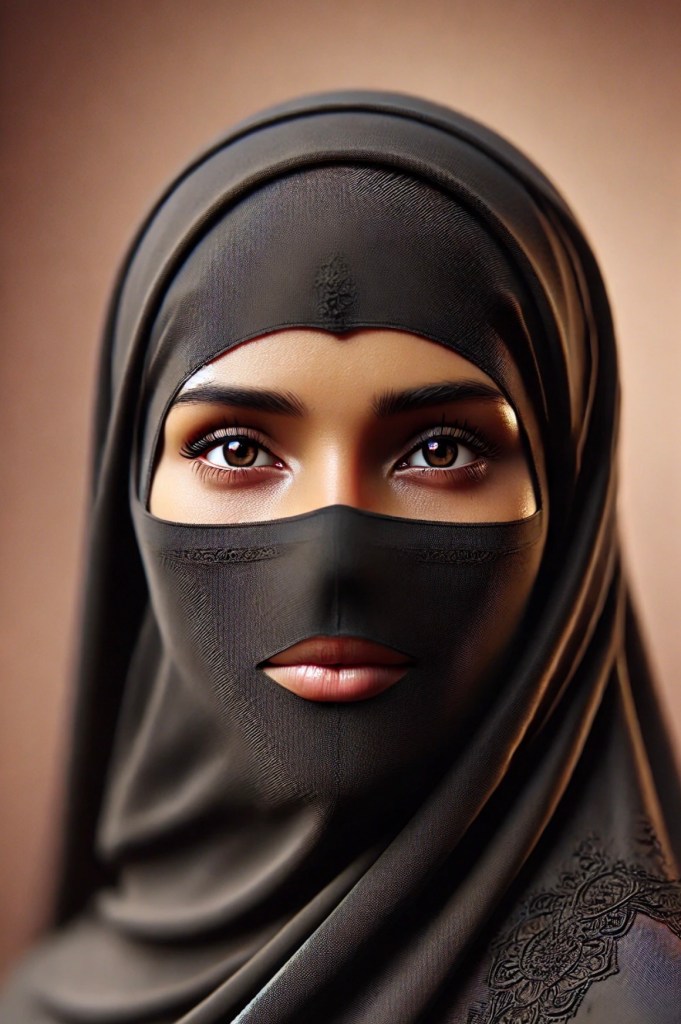
I asked the question to ChatGPT and you can see results below the conclusions were mine.
You can call it faith, identity, or modesty—but if one group carries more responsibility for the same human dynamic, then the system is not equal.
That is the position.
That is the lens through which this question is being asked.
That is the original question.
Not softened. Not redirected. Just asked directly.
What follows are ten commonly given reasons for why women cover—particularly in strict forms like the burqa—alongside the counter-argument that challenges each one. For each, the conclusion is stated plainly: is this suppression or not?
1. Religious Obligation
Claim: Women cover as an act of obedience to God.
Counter: If the rule comes from religion rather than individual will, then the “choice” is constrained. It raises the question: is it obedience, or compliance under belief pressure?
Conclusion: The women are suppressed by their belief of God, but men are not held to the same standard.
2. Modesty Preserves Dignity
Claim: Covering reduces sexualisation and promotes respect.
Counter: This assumes a woman’s visibility is inherently sexual. Why is dignity tied to concealment rather than behaviour?
Conclusion: Women are suppressed by a system that defines their value through how much they hide.
3. Reducing Male Attention
Claim: Covering prevents unwanted male gaze or harassment.
Counter: This shifts responsibility from the observer to the observed. Why are women managing men’s behaviour?
Conclusion: Women are suppressed by being made responsible for male actions.
4. Cultural and Religious Identity
Claim: The burqa expresses belonging and identity.
Counter: Identity can act as a boundary—does this encourage separation rather than integration?
Conclusion: Women are suppressed if identity is enforced rather than freely chosen.
5. Personal Choice
Claim: Many women freely choose to wear it.
Counter: If deviation leads to social, familial, or religious consequences, how free is that choice?
Conclusion: Women are suppressed if the cost of choosing otherwise is too high.
6. Family and Moral Structure
Claim: It aligns with family values and moral expectations.
Counter: When families define morality in restrictive ways, does this limit women more than men?
Conclusion: Women are suppressed when family morality restricts their autonomy.
7. Honour and Reputation
Claim: Modesty protects family honour.
Counter: Why is honour tied primarily to female behaviour rather than equally shared?
Conclusion: Women are suppressed by carrying the burden of family honour.
8. It Is “Natural” Within the Culture
Claim: It feels normal because it is widely practiced.
Counter: Normalisation does not equal fairness—many unequal systems feel “natural” once embedded.
Conclusion: Women are suppressed when inequality is disguised as normality.
9. Commitment to Values
Claim: It reflects discipline, faith, and moral strength.
Counter: When social approval is tied to compliance, commitment can become pressure rather than freedom.
Conclusion: Women are suppressed if values are enforced rather than chosen.
10. Legal and Social Enforcement
Claim: In some places, it is part of the legal or social order.
Counter: If laws enforcing behaviour are created in male-dominated systems, whose interests are being protected?
Conclusion: Women are suppressed when laws restrict them more than men.
Final Line
The argument presented here is consistent across all points:
If a rule limits one group more than another,
if the choice to refuse that rule carries consequences,
and if responsibility is shifted unevenly—
then the system is not neutral. It is suppressive.
Veils, Values, and the Weight of One-Sided Rules 🧕⚖️
A question sharper than a courtroom cross-examination: if modesty, morality, and social order demand more from women than men—are we looking at devotion… or dressed-up inequality?
🎭 The Great Cover-Up Debate: Faith or Fine Print?
Let’s not tiptoe around it. The argument laid out here isn’t confused, conflicted, or coy—it’s a straight-line critique with the subtlety of a sledgehammer.
You’ve got ten neatly packaged justifications, each polished to a cultural shine: faith, dignity, protection, identity. Sounds noble. Almost poetic. Until you notice a recurring plot twist—the burden keeps landing on women like it’s part of the dress code.
If modesty is a virtue, why is it stitched tighter into women’s lives than men’s? If respect is the goal, why does it hinge on concealment rather than conduct? And if “choice” comes with consequences—social exile, family backlash, spiritual guilt—then calling it free is like calling a locked door “optional.”
Let’s be honest: when one group must adjust their behavior, appearance, and freedoms to stabilize the behavior of another, that’s not balance. That’s outsourcing responsibility with a moral bow on top. 🎁
And the pièce de résistance? The claim that it’s all “natural.” Of course it feels natural—so does gravity. But unlike gravity, these rules were written, enforced, and maintained by human systems. Systems that, historically speaking, haven’t exactly been co-authored equally.
This isn’t about dismissing faith or mocking identity. It’s about interrogating the fine print. Because somewhere between devotion and discipline, there’s a line—and it’s worth asking who drew it, and who it binds.
A choice can be real, but still be formed within constraints that shape what feels “right” to choose.
https://chameleon-news.com


 Chameleon Magazine
Leave a comment