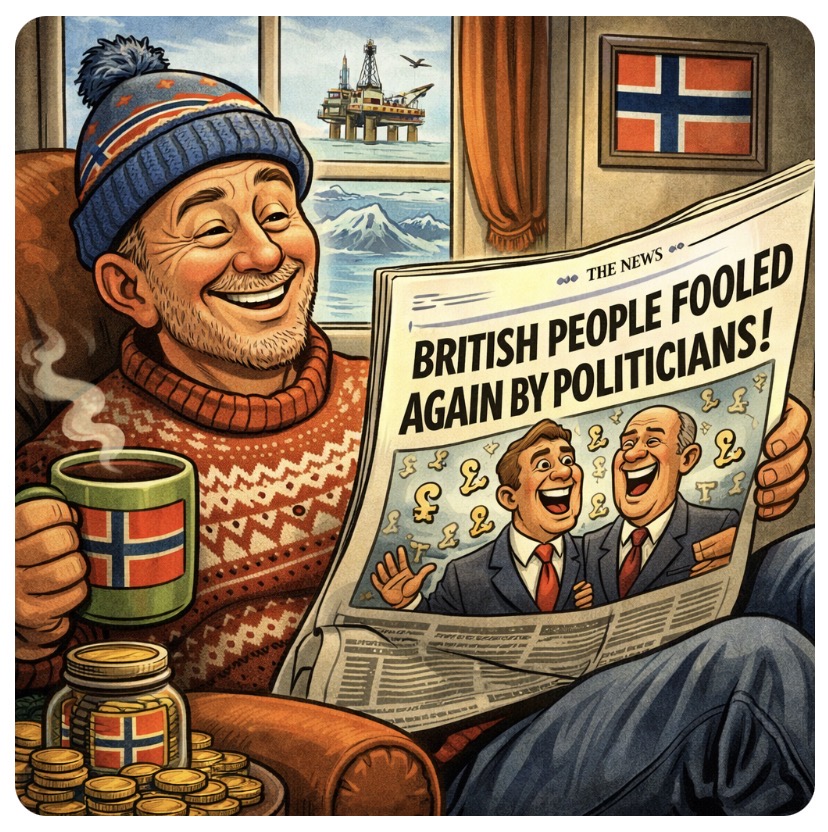
As energy bosses urge Britain to pivot away from North Sea gas and lean harder into renewables, the public is left squinting at their bills wondering: if wind is free… why isn’t my electricity? Meanwhile, across the North Sea, Norway is practically lounging on a sovereign wealth fund the size of a small galaxy. 🛢️💰
🌬️ “It’s Free!” They Cry—While Your Direct Debit Doubles
Enter Octopus Energy, waving the green flag and declaring that the future is breezy, clean, and just over the horizon. Gas? Old news. Wind? Infinite. Bills? …well, let’s circle back to that.
Because here’s the uncomfortable question rattling around British households like a loose window in a storm: if wind power is so gloriously free, why does it feel like we’re paying premium prices for artisan air?
Over in Norway, they took a slightly different approach. Drill the oil. Sell the oil. Invest the profits. Repeat. Now they’ve got a sovereign wealth fund so vast it could probably buy the UK a new kettle—and still have change left for a hydro dam or two.
Meanwhile, Britain’s strategy often feels like trying to win Monopoly by giving away Mayfair and hoping the vibes improve.
And yes—renewables are essential. Of course they are. The planet isn’t exactly sending “thank you” notes for fossil fuels. But the sales pitch has been… optimistic. “Cheap, abundant, clean energy” sounds fantastic—until the bill lands with all the subtlety of a brick through the letterbox. 📬💸
And here’s the part that rarely makes the glossy brochures: gas isn’t just about heating your home or spinning a turbine. It’s a backbone of modern industry. Fertilisers? Largely built on natural gas. Chemicals, plastics, manufacturing inputs—the invisible scaffolding of everyday life leans heavily on it.
Wind turbines don’t produce ammonia. A stiff breeze won’t replace feedstock for fertiliser plants. Oil and gas aren’t just “energy”—they’re raw materials woven into everything from food production to pharmaceuticals.
So when the conversation becomes “just switch it off,” people understandably raise an eyebrow—and their heating bill. 🤨🔥
The truth? Wind isn’t “free” in the way people think. There’s infrastructure, storage, grid balancing, subsidies—all the invisible machinery that turns a gust into a kilowatt. But try explaining that to someone choosing between heating and eating while staring at a turbine spinning majestically in the distance like a smug giant fan.
And that’s where the frustration brews: not with the idea—but with the gap between promise and reality.
🔥 Challenges 🔥
If gas underpins everything from food to fuel… are we having an honest conversation about what replacing it actually means?
Is Britain building a future—or just betting on one?
Drop your take in the blog comments—rage, logic, sarcasm, or all three welcome. 💬⚡
👇 Like it. Share it. Argue about it.
The sharpest takes will be featured in the next issue of the magazine. 📝🔥


 Chameleon Magazine
Leave a comment