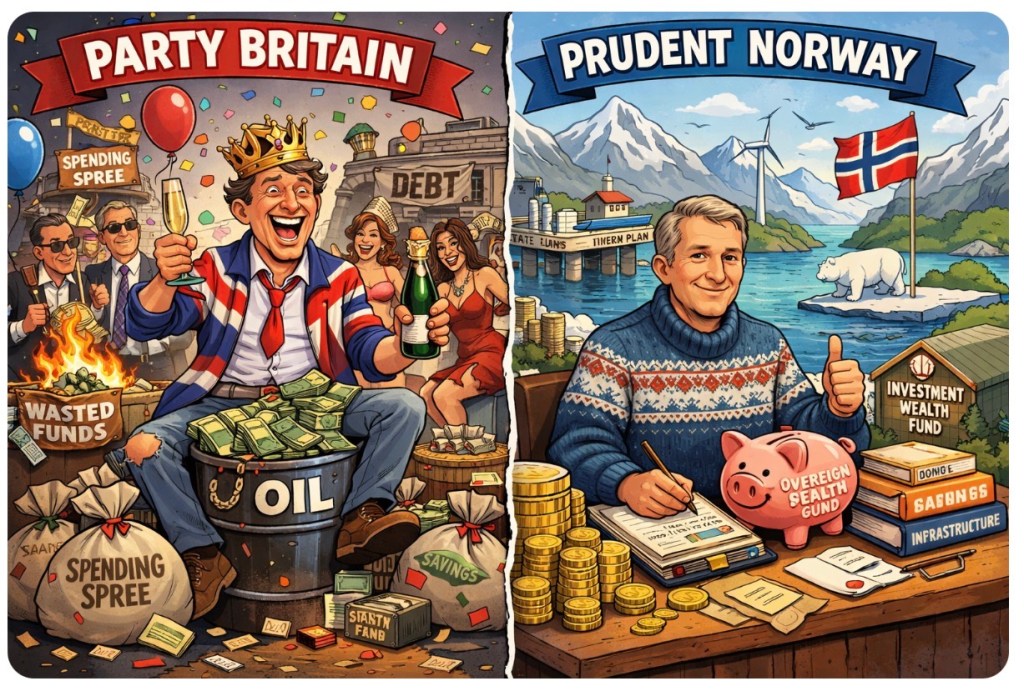
While politicians pace podiums lamenting “limited resources,” entire nations are quite literally sitting on goldmines—oil fields, wind corridors, human capital—and somehow still managing to fumble the bag. The tragedy isn’t scarcity. It’s mismanagement dressed up as inevitability.
🎭 The Great Resource Illusion: It’s Not What You Have, It’s What You Waste
Let’s start with Norway—the overachiever of resource management. They didn’t just strike oil and throw a national spending party. No, they treated it like a volatile asset with the emotional stability of a toddler on espresso. So what did they do? Built a system. Tax it properly. Control it tightly. Invest it wisely. Park it in a sovereign wealth fund so future generations don’t have to sell kidneys to heat their homes.
Result? Stability. Resilience. Actual benefits for actual citizens. Wild concept.
Now enter the chaotic cousin: countries that hit the resource jackpot and immediately start spending like they’ve won the lottery at 2am in Vegas. No structure. No discipline. Just vibes, headlines, and budget black holes. The money comes in—and just as quickly dissolves into bloated systems, political vanity projects, and policies designed to survive the next election cycle rather than the next decade.
And then there’s Switzerland—a nation with no oil, no dramatic natural windfall, and yet somehow thriving like it cracked the cheat code to prosperity. Why? Because instead of digging into the ground, it dug into competence. Precision industries. Financial systems. Trust. Efficiency. It monetised stability like it was exporting gold bars made of good governance.
Meanwhile, others are sitting on literal barrels of oil asking, “But how do we make this work?” 🤡
Let’s be clear: this isn’t bad luck. It’s bad thinking.
Governments keep asking the wrong questions:
- “Should we drill?” instead of “How do we maximise value?”
- “How do we spend this?” instead of “How do we protect and grow this?”
- “What wins votes now?” instead of “What builds wealth over 50 years?”
It’s like inheriting a mansion and immediately renting out the bricks.
The public sees it. That’s the problem. People aren’t blind. They can see the gap between potential and reality—and it’s not subtle. It’s a canyon. And every missed opportunity widens it.
🔥 Challenges 🔥
If the wealth exists, why doesn’t it reach you? 🤔
If the system works elsewhere, why not here?
And the real question—who benefits when nothing changes?
Drop your take directly on the blog. Not just outrage—solutions, sarcasm, or savage honesty. We want all of it. 💬🔥
👇 Comment. Like. Share. Tag someone who still thinks “there’s no money.”
The sharpest takes will be featured in the next issue of the magazine. 🎯📝


 Chameleon Magazine
Leave a comment