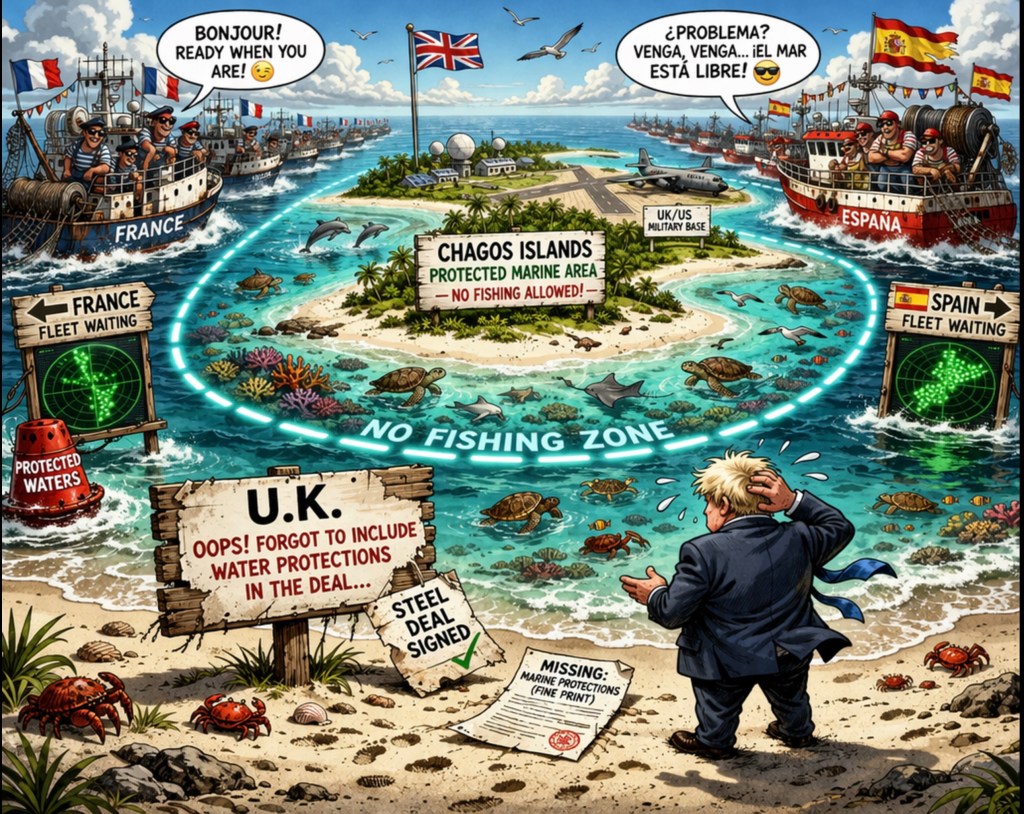
📄🤦♂️🎣Just when you thought the Chagos situation couldn’t look any more like a group project where no one read the brief—along comes another gem: failing to lock in water protections as part of the broader deal… while French and Spanish fleets hover like it’s opening day at an all-you-can-eat ocean buffet.
Because nothing says “strategic control” quite like leaving the door open and acting surprised when guests show up with industrial nets.
🚤 The Sideline Spectators… With Engines Running
Let’s not kid ourselves—this isn’t some hypothetical future problem.
The French and Spanish boats aren’t casually knitting jumpers on the sidelines. They’re circling. Watching. Waiting. Engines warm. Nets folded neatly, ready to drop the second the paperwork ambiguity turns into opportunity. 🇫🇷🇪🇸
And can you blame them? From their perspective, it’s less “illegal incursion” and more “you didn’t say we couldn’t.”
That’s the problem with vague deals—you don’t create peace, you create loopholes. And loopholes, in international waters, tend to get filled very quickly… usually by the biggest fleets with the least hesitation.
🏗️ The Art of the Half-Baked Agreement
There’s a special kind of chaos reserved for deals that tick the big headline boxes—steel, sovereignty, handshakes, photo ops—but quietly forget the actual substance. Like, say… protecting the waters everyone’s now lining up to fish.
It’s the diplomatic equivalent of locking your front door while leaving the back gate wide open with a sign that says, “Probably fine.”
And now? Surprise! The same waters that were supposed to be safeguarded are drifting into that dangerous grey zone—where “protected” becomes “negotiable,” and “negotiable” becomes “who got there first with the biggest trawler.”
🎭 From Global Player to Open Invitation
There’s a creeping sense that Britain’s negotiating posture has shifted from setting the rules to discovering them after everyone else has started playing.
Because missing something this fundamental—while fleets literally wait on standby—isn’t just a slip. It’s practically an invitation.
An invitation that says:
“Come back later… we might have forgotten to stop you.”
And guess what? They will.
🔥 Challenges 🔥
Are we negotiating deals—or quietly hosting a maritime free-for-all? 🤨🌊
Why do others arrive prepared while we arrive… optimistic? And how long before “waiting on the sidelines” turns into “already emptied half the sea”?
Drop your take in the blog comments—rage, sarcasm, or brutal honesty all welcome. 💬🔥
👇 Hit comment, like, and share—because if the boats are already lining up, the least we can do is start asking who left the gate open.
The sharpest takes will be featured in the next issue of the magazine. 🎯📝


 Chameleon Magazine
Leave a comment