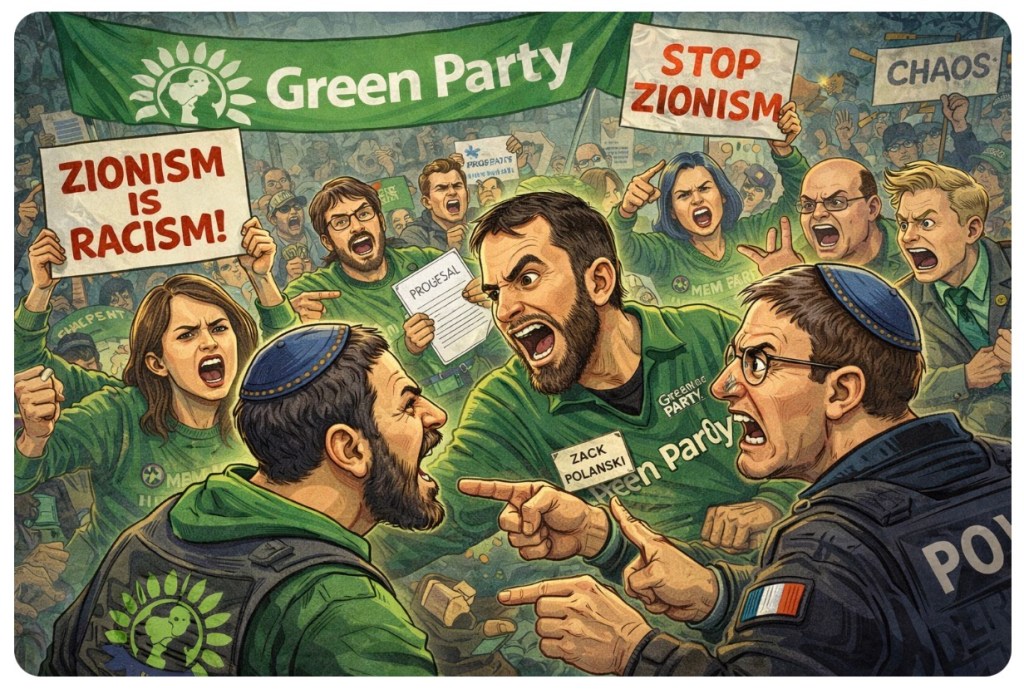
The image of the Green Party—calm, ethical, bike-riding custodians of the planet—is starting to look a little… frayed at the edges. What was once all reusable coffee cups and wind turbines is now veering into something far more combustible: identity, ideology, and internal fracture.
🌪️ From Climate Calm to Political Storm
The recent chaos inside the Green Party of England and Wales—sparked by a vote on whether Zionism should be classified as racism—has exposed something deeper than a single controversial motion.
It’s not just about the issue itself. It’s about what happens when a party built on broad moral principles suddenly has to define them under pressure.
And define them precisely.
Because once you move beyond “save the planet” into geopolitics, history, identity, and conflict, things get messy—fast.
The debate around Zionism isn’t a niche internal policy tweak. It touches on Jewish identity, international conflict, free speech, and accusations that can carry serious weight. Trying to compress all of that into a single party motion? That’s like trying to solve climate change with a sticky note.
So what happened?
Confusion. Division. Procedural chaos. No clear decision.
Not exactly the image of a party ready to govern.
And figures like Zack Polanski—who represent a more activist, outspoken wing—highlight a broader shift. The party isn’t just about environmental stewardship anymore. It’s becoming a platform for a wider set of ideological battles.
That’s not necessarily a problem—but it is a transformation.
Because the more issues you absorb, the harder it becomes to maintain a coherent identity.
Once upon a time, the Greens could unite around trees 🌳
Now they’re dividing over terminology, definitions, and global politics.
That’s a very different battlefield.
And here’s the uncomfortable truth:
The “green and friendly” image was always easier to maintain when the stakes were less politically explosive. Climate policy is serious—but it’s also broadly unifying among supporters. Identity politics? That’s where coalitions start to crack.
Is this growth—or is it mission drift? 🤔
Can a party stay unified while expanding into every major ideological debate?
And at what point does “having principles” turn into “having internal chaos”?
Drop your take directly on the blog—measured, furious, or somewhere in between. 💬🔥
Call it out, break it down, or defend it—but don’t sit on the fence.
👇 Comment. Like. Share. Tag someone who still thinks the Greens are just about recycling bins.
The sharpest takes will be featured in the next issue of the magazine. 🎯📝


 Chameleon Magazine
Leave a comment