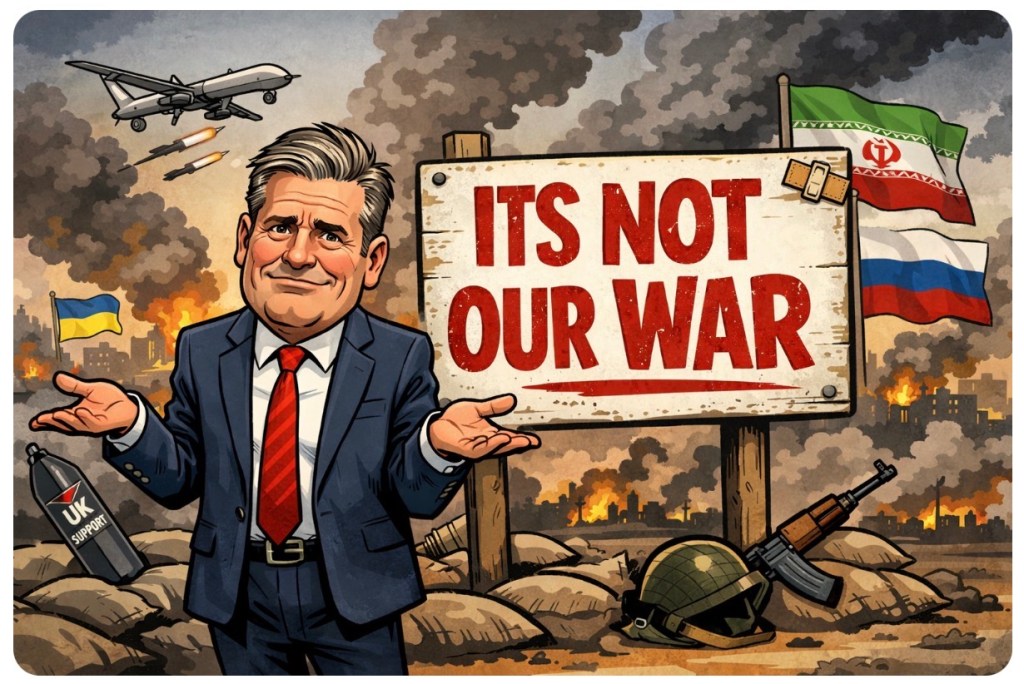
While prices climb faster than political excuses, Keir Starmer rolls out the diplomatic equivalent of “not my problem” — declaring conflicts abroad as somehow detachable from Britain’s reality. A bold strategy… if Britain weren’t already knee-deep in alliances, airspace incidents, and economic fallout.
🎭 The Great British Shrug: Now Available in Foreign Policy Edition
Apparently, war now comes with an on/off switch. Ukraine? Oh yes, very much our concern. Middle East tensions? Suddenly we’re spectators with binoculars and a polite cough.
But here’s the snag — global politics isn’t a buffet where you pick solidarity in Kyiv and skip consequences in Tehran. Britain backs Ukraine against Russia. Russia backs Iran. British forces intercept drones in the Middle East. Yet somehow, we’re told this isn’t “our war”?
That’s not strategy — that’s geopolitical gymnastics with a blindfold on. 🤹♂️
Meanwhile, voters at home are watching bills balloon like they’ve been on a government-funded diet. Energy, food, fuel — all dancing to the rhythm of global instability. Funny how wars we’re “not part of” still manage to empty wallets across the UK.
And let’s not pretend timing is accidental. With May elections looming, nothing soothes public anxiety like a well-placed distancing statement. “Not our war” sounds reassuring — until reality taps you on the shoulder and hands you the receipt.
Because here’s the uncomfortable truth:
In a globalised world, conflict doesn’t ask for permission before affecting you. It just… does.
🔥 Challenges 🔥
So where do you stand? Is this smart political messaging — or a dangerously convenient illusion? 🤔
Are we witnessing leadership… or linguistic gymnastics designed to dodge accountability?
Drop your take directly on the blog — not just a scroll-past grumble. Let’s hear the sharpest arguments, the hottest takes, and the coldest truths. 💬🔥
👇 Comment, like, and share if you think “not our war” is the most expensive sentence Britain might regret.
The best comments will be featured in the next issue of the magazine. 🎯📝


 Chameleon Magazine
Leave a comment