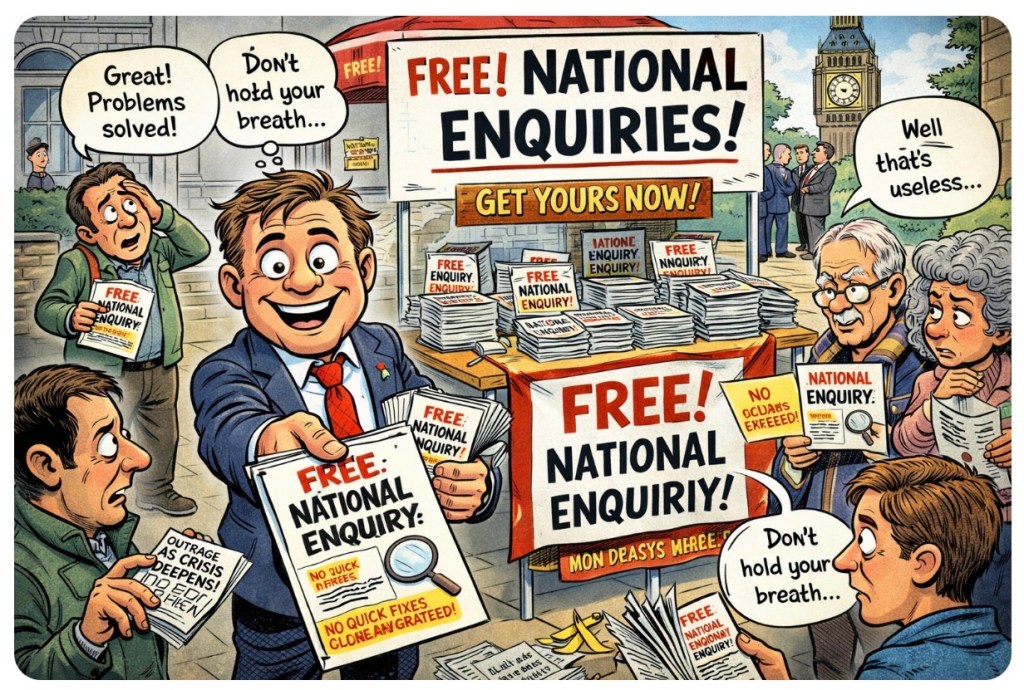
🕵️♂️📄Ah yes, the “National Enquiry”—that magical phrase politicians deploy when things have gone so catastrophically wrong that someone has to look like they’re doing something. Preferably something that takes years, costs millions, and concludes long after everyone involved has retired, resigned, or conveniently forgotten. 🇬🇧✨
🧾 The Great British Delay Tactic
Let’s break it down. A national enquiry is announced with maximum gravity:
“We must get to the bottom of this.”
Translation: We need to buy time, shift blame, and hope the public gets distracted by the next scandal.
Panels are assembled. Experts are called. Papers are shuffled. Coffee is consumed at alarming levels. And then… nothing. For months. Years, even.
By the time the final report drops—thousands of pages long and heavier than a small child—it usually tells us what everyone already knew:
- Mistakes were made
- Systems failed
- Lessons must be learned
Groundbreaking stuff. Truly. Nobel Prize material. 🏆
🧠 Insight or Institutional Amnesia?
Here’s the real kicker: enquiries rarely change anything in a meaningful, lasting way.
They’re brilliant at:
- Documenting failure 📚
- Assigning vague responsibility 🤷♂️
- Recommending improvements no one is legally required to follow
But when it comes to actual accountability? Structural reform? Prevention?
Suddenly it’s all a bit… foggy. Like trying to grab smoke with oven mitts.
And let’s not ignore the timing. Enquiries conveniently stretch beyond election cycles, meaning the people responsible are often long gone by the time conclusions land. It’s not justice—it’s a bureaucratic time machine. ⏳
🎭 Theatre of Accountability
At this point, national enquiries feel less like investigations and more like political theatre:
- Step 1: Public outrage erupts 🔥
- Step 2: Government announces enquiry 🎤
- Step 3: Media coverage fades 📉
- Step 4: Report released quietly on a Tuesday afternoon 📰
- Step 5: “We will carefully consider the findings” 🤐
And scene. Curtain closes. Nothing fundamentally changes.
So here’s the uncomfortable question: are national enquiries actually about truth—or are they just the UK’s most expensive way of stalling consequences?
If they really worked, wouldn’t we need fewer of them by now?
Drop your thoughts in the blog comments—are enquiries a necessary tool for accountability, or just a polished delay tactic wrapped in official language? 💬🔥
👇 Like, share, and call it out. Who’s fooling who here?
The sharpest takes will be featured in the next issue of the magazine. 📝⚡


 Chameleon Magazine
Leave a comment