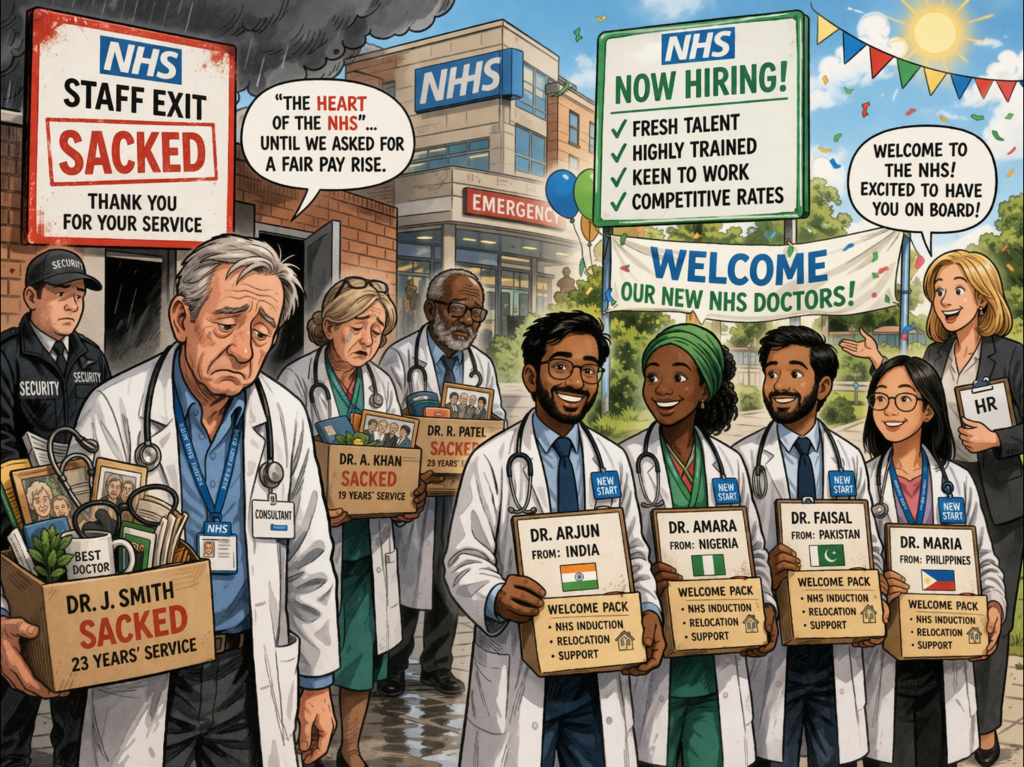
Ah yes, the bold new policy proposal straight from the “What Could Possibly Go Wrong?” playbook: if doctors strike, sack them all and replace them with cheaper alternatives flown in from overseas—India, Nigeria, Pakistan, the Philippines—anywhere with trained professionals ready to step into a system already creaking at the seams. Because clearly, running a national healthcare system is basically the same as switching to a budget supermarket brand. 🛒
🧨 Clearance Sale NHS: Everything Must Go!
Picture the scene: years of training, experience, and institutional knowledge—out the window. In comes a fresh batch of doctors, expected to plug gaps instantly, navigate a complex system, and somehow improve things… all while being cheaper.
Brilliant. Flawless. What’s next—two-for-one surgeons on weekends? 🧾
And let’s not pretend this wouldn’t send a message loud and clear to every healthcare worker:
“You’re replaceable. Don’t like it? There’s the door.”
Nothing boosts morale like a little existential job insecurity with your morning coffee. ☕😬
🌍 The “Cheaper Option” Fantasy
Then there’s the idea of bringing in migrant doctors from countries like India, Nigeria, Pakistan, and the Philippines as a cost-saving measure—as if they’re some kind of NHS discount code.
Let’s pause there.
These are highly trained professionals, not a budget workaround. Treating them as a cheaper substitute rather than valued contributors raises a bigger question about how we value skills, expertise, and the people holding the system together.
Because if the plan is simply “find someone cheaper,” where exactly does that logic stop?
🫀 “The Heart of the NHS”… Until It’s Inconvenient
For years, we’ve been told doctors are the “heart of the NHS”—heroes in a crisis, clapped on doorsteps, paraded in speeches. But the moment they push back on pay, conditions, or sustainability, that narrative seems to wobble.
So which is it?
If they’re truly indispensable, why is the conversation suddenly about replacing them with “more keen” and cheaper alternatives? And if they’re that easily swapped out, were we sold a convenient myth all along—one that sounds great in speeches but quietly collapses when budgets get tight?
It raises an uncomfortable contradiction: are we valuing expertise and experience… or just applauding it when it’s convenient? 👏➡️💸
🧠 Strategy or Short-Term Panic?
This kind of thinking feels less like long-term planning and more like panic dressed up as policy.
- Replace instead of resolve
- Cut costs instead of fixing causes
- React instead of plan
It’s the same short-term cycle—just applied to healthcare this time.
And we all know how well that’s worked elsewhere… 🙃
🔥 Challenges 🔥
So here’s the question—and this time, no dodging it:
Should striking doctors be sacked and replaced with cheaper alternatives from abroad—India, Nigeria, Pakistan, the Philippines—or is that a fast-track to breaking the system entirely?
Is this bold leadership—or bargain-bin desperation?
Drop your take in the blog comments—no fence-sitting, no safe answers. 💬🔥
👇 Like, share, and stir the pot. This one’s going to divide opinions.
The sharpest, boldest, and most brutally honest comments will be featured in the next issue of the magazine. 📝⚡


 Chameleon Magazine
Leave a comment