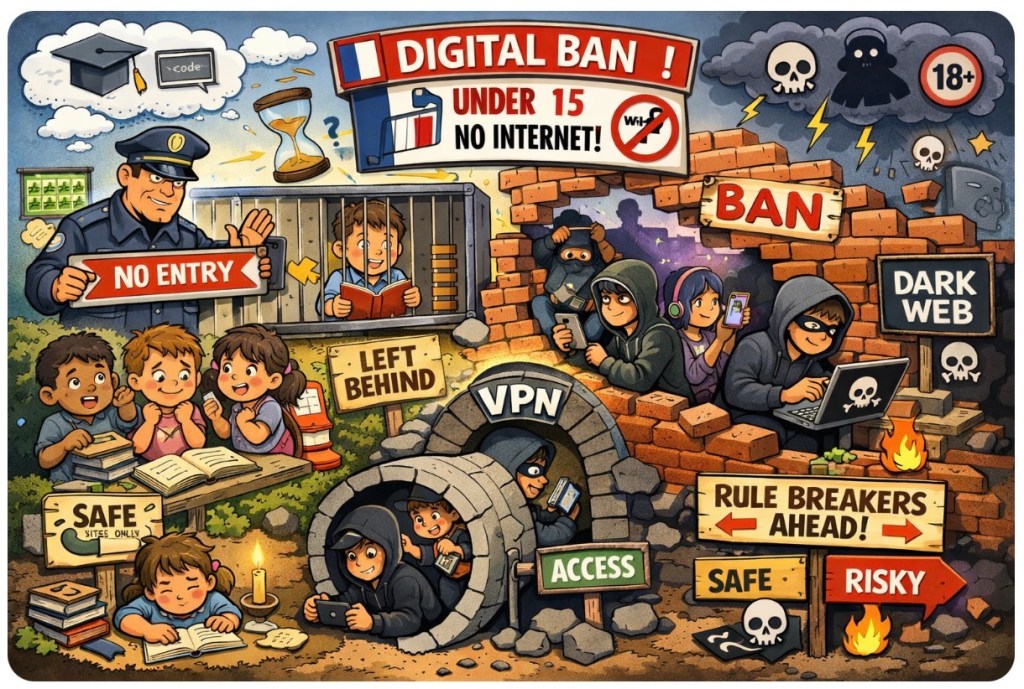
While the rest of the world wrestles with algorithms, dopamine loops, and digital chaos, France has apparently decided the solution is… unplug the kids entirely. No messy reforms, no digital literacy revolution—just a clean, bureaucratic “non.” Problem solved, baguette secured. 🥖✔️
🧠📵 The Great Wi-Fi Witch Hunt
Let’s be honest—this isn’t bold leadership, it’s parental control at a national level. Instead of teaching young people how to navigate the digital jungle, policymakers have essentially said: “Too complicated. Turn it off.”
It’s the equivalent of banning kitchens because someone burned toast. 🍞🔥
Sure, the internet is chaotic—misinformation, addictive platforms, questionable content—but it’s also where innovation, learning, and opportunity live. Blocking access doesn’t make kids safer; it makes them sneakier and less prepared. Because here’s the uncomfortable truth: you don’t win the future by hiding from it.
Meanwhile, countries that invest in digital literacy, coding education, and critical thinking are effectively training their kids to run the internet—not fear it. And France? It risks raising a generation that can write essays about the web… but not actually use it effectively.
And let’s not pretend bans work. Teenagers have bypassed stricter controls than this just to watch region-locked Netflix shows. You really think a 15-year-old with Wi-Fi and curiosity is going to be stopped by a policy document? Please. 😏
But here’s where it gets even messier…
The kids who do get ahead won’t be the rule-followers—they’ll be the rule-breakers. The ones sidestepping restrictions, installing VPNs, dodging safeguards. And where does that road often lead? Not just to harmless workarounds, but to the unfiltered, unmoderated corners of the internet—the kind adults claim they’re trying to protect them from in the first place. 🌑🕳️
So now we’ve flipped the script entirely:
The “advantaged” kids become the ones ignoring the law.
The “protected” kids become the ones left behind.
That’s not policy—that’s a paradox.
Because while some of these digital rebels may gain skills, awareness, and technical confidence… they’re also navigating spaces without guidance, without guardrails, and without context. And that’s a dangerous kind of education—one that teaches capability without judgment.
Will they surge ahead? Probably.
Will it be the right kind of progress? That’s a far murkier question.
Only time will tell whether this experiment produces sharper minds—or just better rule-breakers. ⏳⚖️
🔥 Challenges 🔥
Are we accidentally rewarding rebellion and penalising compliance? Is this the birth of a smarter generation—or just a sneakier one?
Drop your take in the blog comments—does banning access protect kids, or push them into the shadows? 💬🔥
👇 Like, share, and comment your hottest take. Are we building digital leaders—or digital outlaws?
The boldest, sharpest comments will be featured in the next issue of the magazine. 🎯📝


 Chameleon Magazine
Leave a comment