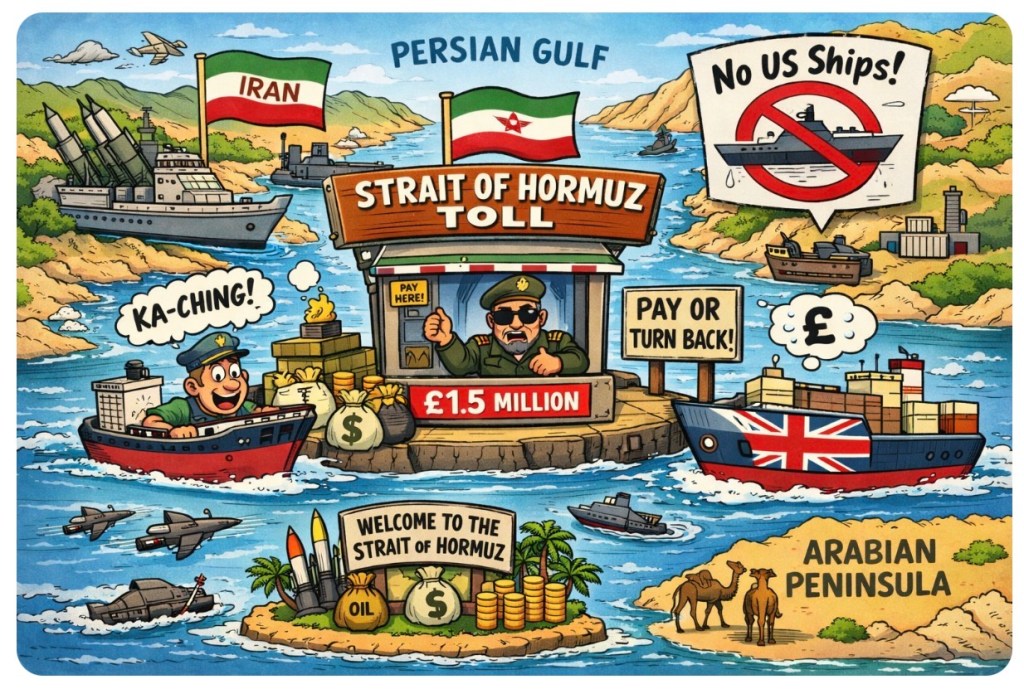
So now the Strait of Hormuz isn’t just a chokepoint—it’s apparently flirting with becoming the world’s most expensive toll road. According to statements coming out of Iran, ships may soon need to cough up eye-watering fees just to pass through, while certain nations—like the United States—could find themselves flat-out banned.
And sitting nervously refreshing oil prices? The ever-dependent United Kingdom. Because when your energy lifeline runs through someone else’s front garden, you don’t get to complain about the garden rules—you get the invoice. 🧾⛽
🚧 Welcome to the World’s Most Expensive Toll Booth 🚧
Imagine it: not a warzone, not a blockade—just a glorified barrier gate in the middle of global trade. “That’ll be £1.5 million, mate, or turn your tanker around.” 🚢💷
It sounds absurd. It is absurd. But it’s also a glimpse into a brutal reality—control the chokepoint, control the pressure. And right now, Iran knows exactly where the pressure valve sits.
This isn’t about drones anymore. This is about leverage. Pure, unapologetic leverage.
You don’t need to fire a shot when you can squeeze the world’s oil supply like a stress ball and watch economies twitch in real time. Prices spike, markets panic, governments scramble—and suddenly “energy policy” isn’t a debate, it’s a survival strategy. 📉🔥
And let’s not pretend this is happening in a vacuum. Iran framing this as payback for actions involving the US, Israel, and Britain? That’s geopolitics with a receipt attached. You break it, you bought it—except now the bill comes with interest and a maritime surcharge.
Meanwhile, back in Westminster, the great balancing act continues. Enter Ed Miliband, pushing Net Zero ambitions while global energy routes look shakier than a supermarket trolley with one dodgy wheel.
Critics are yelling: “We’re importing energy through a toll booth run by someone who doesn’t like us—and we’re phasing out our backups? Brilliant.” 👏😐
Supporters fire back: “Exactly why we need independence from global chokepoints.”
And the public? Watching their bills creep up like a horror film soundtrack.
Because here’s the uncomfortable truth: if access to oil becomes restricted, delayed, or extortionately priced, the UK doesn’t get a gentle warning. It gets a shock. Fast. Transport, heating, food logistics—everything starts to feel the squeeze.
Not collapse overnight. But not comfortable either.
And that image—Britain, once the empire that ruled the waves, now nervously checking if it can afford passage through someone else’s—isn’t just satire. It’s a shift in power dynamics playing out in real time. 🌍⚖️
🔥 Challenges 🔥
So here’s the question—when did we become this exposed? And more importantly, what are we actually going to do about it? 🤔
Is this smart strategy from Iran, reckless escalation, or a wake-up call the UK has been snoozing through?
Don’t just shout at your screen—take it to the blog comments. Bring your sharpest takes, your hottest anger, or your coldest logic. 💬🔥
👇 Like, share, and speak up—because if the world’s turning into a pay-to-play system, we’d better decide where we stand.
The best comments will be featured in the next issue of the magazine. 🎯📝


 Chameleon Magazine
Leave a comment