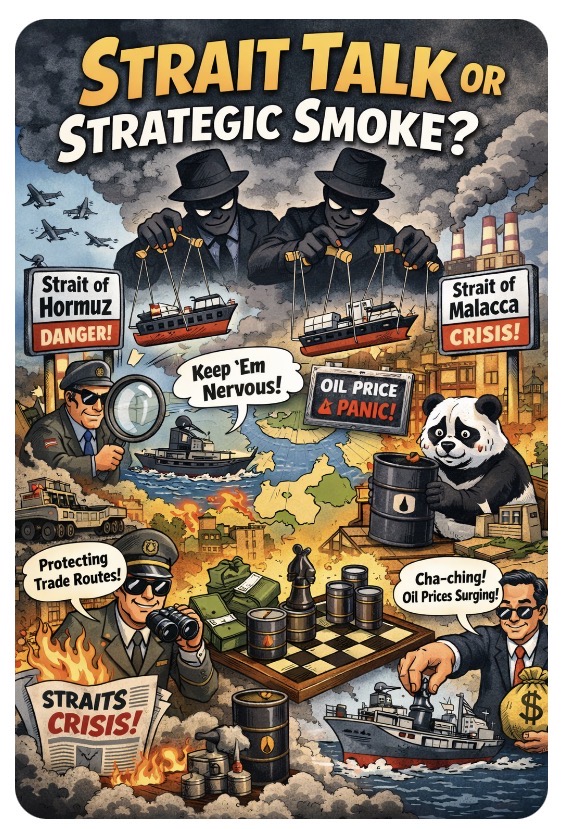
🚢🛢️We’re being told—again—that the world is one blocked shipping lane away from total economic meltdown. Cue the dramatic maps, the urgent panels, and the endless name-dropping of the Strait of Hormuz and the Strait of Malacca like they’re the final bosses of global trade. 🎮
But let’s cut through the theatrics:
Is this really about fragile shipping routes… or is “the straits crisis” just a well-dressed excuse for geopolitical leverage? 🤨
🎬 Manufactured Panic: When Maps Do the Scaring for You
The story we’re sold is beautifully simple:
“If a strait gets blocked, oil stops flowing, the economy collapses.”
Clean. Terrifying. Slightly too convenient.
Because here’s what doesn’t make the headline:
- Oil moves through a massive, flexible global network—not a single choke valve
- Countries maintain strategic reserves precisely for these “emergencies”
- Even real disruptions tend to cause price spikes, not long-term global collapse 📈
In other words, the crisis is often less about reality… and more about reaction.
🧠 The Real Game: Pressure Without the Paper Trail
So if it’s not really about the straits collapsing the system overnight—what is it about?
Simple: leverage.
- Economic pressure on rivals
A tight market hits import-heavy giants like China exactly where it hurts - Justifying military presence
“We’re here to protect shipping lanes” sounds far more noble than “we’re here to project power” ⚓ - Market manipulation via fear
You don’t need to block oil—just hint that you might, and watch prices jump - Influence over global flow
Control the narrative, and you subtly control the system
No grand announcement. No official memo. Just pressure applied quietly, denied loudly.
🔥 Controlled Chaos: The Sweet Spot of Power
Here’s the part nobody says out loud:
A full shutdown of a major strait would be catastrophic—for everyone.
So that’s not the goal.
The real sweet spot?
👉 Permanent tension without total breakdown
- Enough instability to spook markets
- Enough risk to justify action
- Enough uncertainty to shift alliances
It’s not about stopping oil.
It’s about controlling how nervous everyone is about it. 😏
⚖️ The Verdict: It’s Not the Route—It’s the Leverage
So next time you hear about a looming “straits crisis,” ask yourself:
- Who benefits from the fear?
- Who gains influence when prices spike?
- Who suddenly has a reason to move ships, troops, or policy?
Because the real power move isn’t blocking oil.
It’s making the world believe you can. 🎯
🔥 Challenges 🔥
Are we watching genuine risk—or a perfectly crafted narrative to justify power plays behind the scenes?
Is the fear of disruption more valuable than disruption itself?
Drop your take directly on the blog—sharp, skeptical, or savage. 💬🔥
👇 Like, share, and tag someone who still thinks this is just about shipping routes.
The boldest takes will be featured in the next issue. 📝⚡


 Chameleon Magazine
Leave a comment