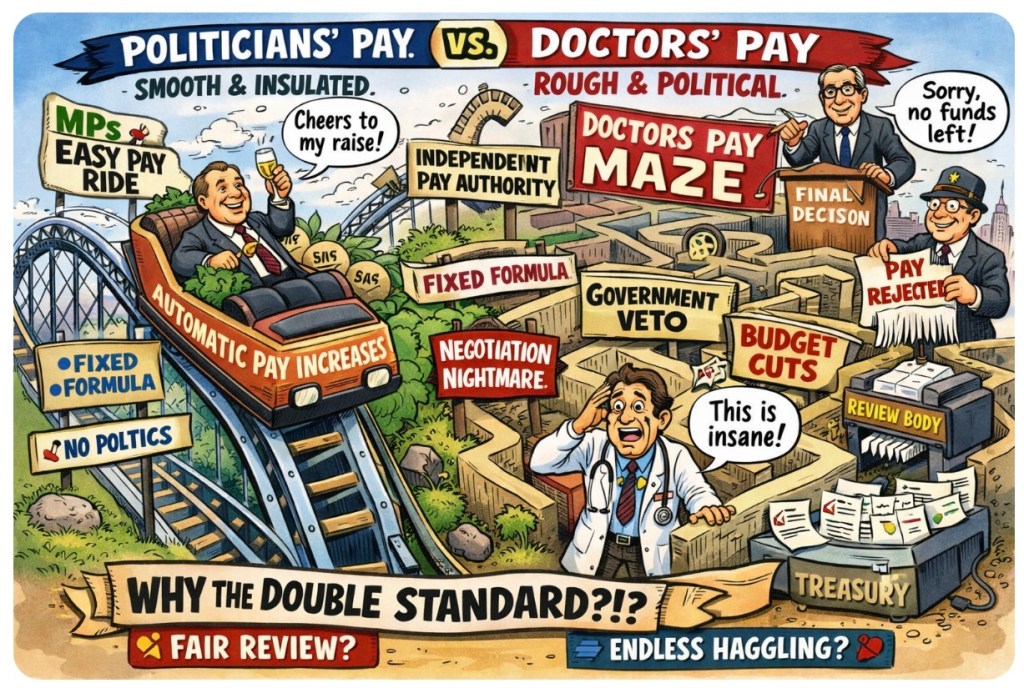
While MPs glide along a tidy, formula-driven pay track overseen by the Independent Parliamentary Standards Authority, doctors are left navigating a political obstacle course where “independent review” sounds reassuring—right up until the government bins the recommendation. Welcome to Britain’s favourite institutional contradiction: precision economics for politicians, vibes-based budgeting for the people keeping you alive.
🧮 The Algorithm for Them, the Argument for You
Let’s get this straight. MPs’ salaries are benchmarked, indexed, and adjusted with all the calm predictability of a well-behaved spreadsheet. It’s tidy, technocratic, and—crucially—insulated. The system is designed to remove political interference so MPs don’t have to vote on their own pay rises (how noble).
Meanwhile, doctors? Their pay flows through the Review Body on Doctors’ and Dentists’ Remuneration, which recommends changes based on evidence, workforce data, and—brace yourself—reality. And then… the government steps in, squints at the numbers, checks the fiscal weather, and decides whether those recommendations are “affordable” this year. Translation: evidence is optional; budgets are king. 👑
So here’s the uncomfortable question:
If MPs deserve insulation from political pressure, why don’t doctors deserve insulation from political convenience?
Because right now, one group gets a system designed to ensure fairness over time… and the other gets a system designed to manage costs over time.
🎓 Ten Years Training vs Ten Minutes Debating
Doctors invest a decade (or more) in structured education, clinical training, exams, and continuous development. They carry legal liability, life-or-death responsibility, and a regulator breathing down their neck. Their labour market is highly specialised, globally competitive, and brutally demanding.
MPs? No formal qualification required. Election is the gateway. Their role is undeniably important—but it is not built on a rigid pipeline of human capital investment in the same way.
So why does the less standardised role have the more standardised pay protection?
That’s not an argument to cut MPs’ pay—it’s an argument that doctors’ pay-setting mechanism is structurally weaker.
⚖️ The Real Issue: Scrutiny vs Selective Scrutiny
MPs often defend the status quo with a familiar line: “We rely on independent bodies.”
Yes—for their own pay.
But when it comes to doctors, independence becomes… negotiable. Recommendations can be diluted, delayed, or ignored entirely depending on fiscal pressures or political optics. The result? A slow erosion that doesn’t happen overnight—but absolutely happens over time.
So here’s the sharper challenge:
👉 If independent review is good enough to protect MPs from bias,
👉 why isn’t it binding when it comes to protecting doctors from erosion?
Because what we’re really seeing isn’t a difference in roles—it’s a difference in how seriously “independence” is taken.
Why do we accept a system where those making life-and-death decisions are paid through negotiation, while those making policy decisions are paid through insulation? 🤔
Is this about fairness—or just what’s politically convenient to protect?
And here’s the real kicker: if the system quietly undervalues doctors over time, what happens to retention, morale, and ultimately patient care?
Drop your take directly on the blog—don’t just shout into the social media void. We want the sharpest arguments, the hottest takes, and the coldest truths. 💬🔥
👇 Comment, like, share—call it out or defend it, but don’t sit on the fence.
The best responses will be featured in the next issue of the magazine. 🎯📝


 Chameleon Magazine
Leave a comment