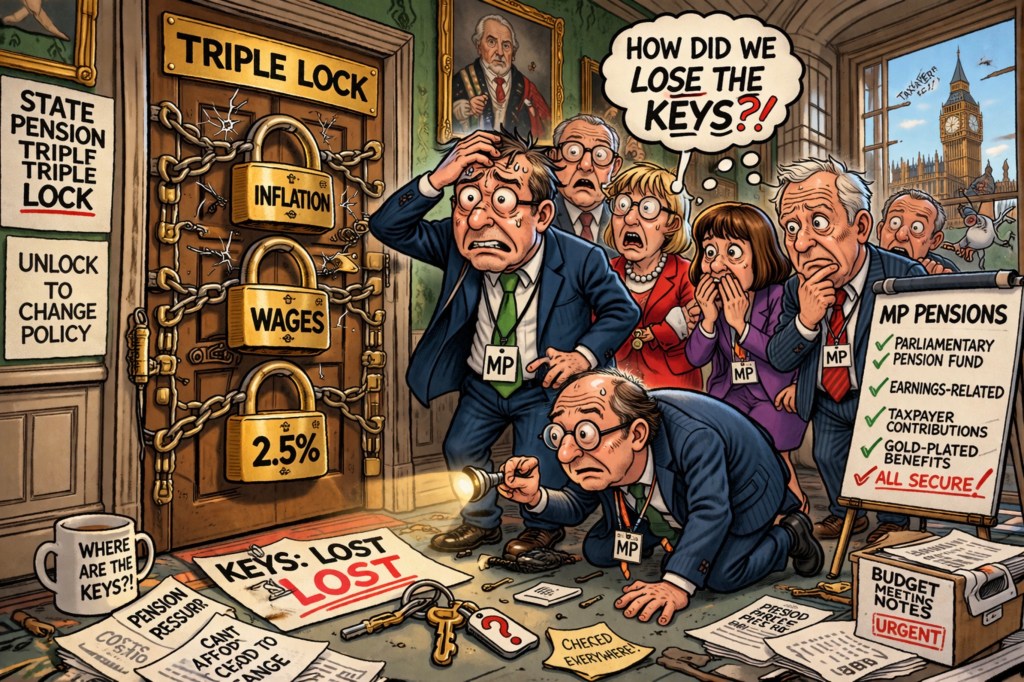
Ah yes, the grand British pastime: invent a policy, pass it through layers of “scrutiny,” then act shocked years later when it does exactly what it was designed to do. The triple lock—that shiny guarantee that pensions rise by the highest of inflation, wages, or 2.5%—was ushered in under David Cameron and George Osborne. And yes, it went through Parliament, nodded at by committees, debated in the Commons, and politely tea-sipped through the Lords.
So how, pray tell, did we end up here—with critics yelling “idiots!” at the architects of a policy that sailed through the full machinery of government?
🎭 The Great Westminster Sleepover (Or: “Don’t Worry, It’ll Be Fine”)
Let’s not kid ourselves. This wasn’t some rogue back-of-a-napkin idea smuggled into law at 3am. The triple lock strutted through the halls of power like it owned the place. MPs debated it, Lords reviewed it, economists raised eyebrows—and yet, onward it marched.
But here’s the uncomfortable truth:
bad long-term policy doesn’t require stupidity—just short-term incentives.
Politicians weren’t asleep. They were wide awake… staring directly at the electoral maths. Pensioners vote. A lot. And reliably. Lock in a generous, easy-to-explain benefit? Political genius in the short term. Long-term affordability? That’s Future Britain’s problem. Kick the can, collect the votes, move along.
🏦 Gold-Plated Irony: Their Pensions vs Yours
Now let’s sprinkle in the part that really makes the tea taste bitter ☕—politicians’ own pensions.
MPs aren’t exactly relying on the state pension they’re so eager to “protect.” They’ve got access to the Parliamentary Contributory Pension Fund, a scheme that has historically been far more generous than what most workers get—and certainly more structured than the basic state pension safety net.
While the public debates whether the triple lock is “sustainable,” many of the very people making that call are accruing pensions that:
- Are earnings-related, not flat-rate
- Include solid employer contributions (read: taxpayer-funded top-ups 💸)
- Offer far more predictability than the political football that is the state pension
So when politicians wax lyrical about “protecting pensioners,” it’s worth asking:
whose retirement are they really worried about?
It’s a bit like someone dining at a five-star restaurant arguing passionately about how important instant noodles are for the masses.
🧠 System Failure or System Working Perfectly?
Here’s where your point cuts deep: if you’re blaming individuals alone, you’re missing the bigger picture. The triple lock isn’t a glitch—it’s a feature of a political system that:
- Rewards policies that win votes now
- Discounts costs that land later
- Spreads responsibility so thin that accountability evaporates
By the time the bill becomes a burden, the original decision-makers are on the lecture circuit, writing memoirs, or judging reality TV (metaphorically… mostly).
And Parliament? It didn’t fail to notice. It simply failed to stop it—because stopping it had a higher political cost than passing it.
🔥
Challenges
🔥
So here’s the real question:
Was this incompetence… or calculated convenience dressed up as compassion?
And while we’re at it—should the people designing pension policy be sitting comfortably on schemes far removed from the reality of everyone else?
💬 Drop your take directly on the blog—don’t just shout into the social media void. Who’s accountable: the politicians, the system, or the voters themselves?
👇 Like, share, and unleash your best (or worst) take in the comments.
The sharpest insights—and the most savage roasts—will be featured in the next issue. 📝🔥


 Chameleon Magazine
Leave a comment