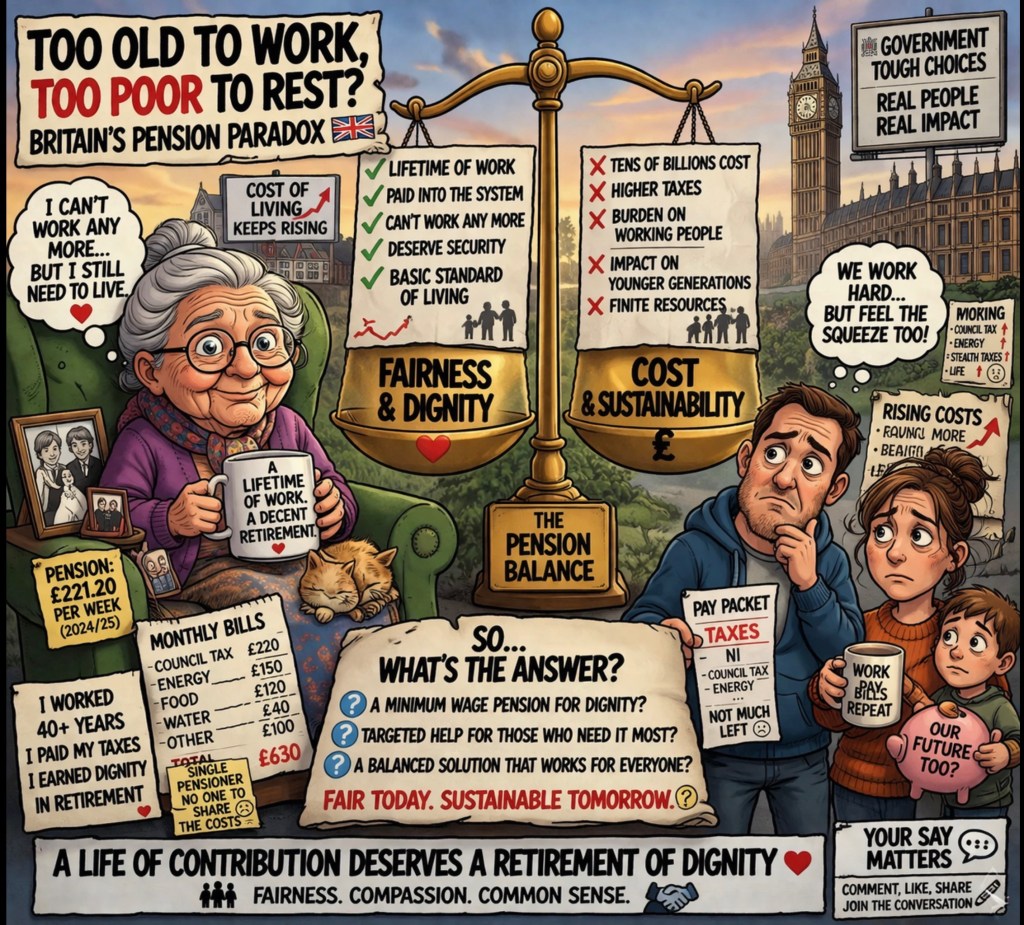
Here’s the contradiction at the heart of the debate:
we’re told pensions can’t be too generous because of cost…
yet we also hear complaints that pensioners are “not working.”
Well—which is it?
Because the reality is far less convenient than either argument admits.
🪑 The Myth of “Not Working”
Let’s kill this idea straight away.
Pensioners aren’t sitting around choosing not to work like it’s an extended gap year. Most have:
- Worked for 40+ years 🛠️
- Paid into the system consistently
- Reached a point where they physically can’t continue
So framing pensions as money for people “not working” misses the point entirely.
They’re not unemployed—they’re retired. There’s a difference.
And it’s a difference built on time, contribution, and, quite often, declining health.
⚖️ The Minimum Wage Question
Now here’s where things get interesting.
Should a single pensioner receive something equivalent to minimum wage?
On the surface, it makes sense:
- A full-time worker is guaranteed a baseline standard of living
- So why shouldn’t someone who’s already done a lifetime of work get the same?
Especially when single pensioners:
- Carry all household costs alone 🏠
- Have no flexibility to “earn more”
- Are hit hardest by rising living costs
It stops feeling like generosity…
and starts looking like basic fairness.
💣 The Financial Brick Wall
But then reality barges in like an unpaid bill.
Link pensions to minimum wage, and suddenly:
- Costs explode into the tens of billions 💸
- Taxes likely rise—especially on working households
- Younger generations start asking uncomfortable questions
Like:
“Why are we funding a retirement standard we don’t even have ourselves?”
And just like that, fairness turns into friction.
🪙 The Real Tension: Fairness vs Sustainability
This is where both sides collide.
On one hand:
- Pensioners can’t work
- They’ve already contributed
- They deserve security and dignity
On the other:
- The system has finite resources
- Workers are already feeling squeezed
- Promises made today become burdens tomorrow
So the debate isn’t really about whether pensioners deserve more.
It’s about:
How much fairness can the system actually afford?
🧠 The Uncomfortable Truth
Both arguments are right—and that’s the problem.
- It is unfair for pensioners to struggle after a lifetime of work
- It is difficult to fund a minimum-wage-level pension for millions
So instead of a clean answer, we get a messy compromise:
- Modest increases
- Targeted support
- And a lot of political tap-dancing around the real issue
Because no one wants to say it outright:
You can’t fully satisfy fairness and affordability at the same time.
🔥
Challenges
🔥
So here’s the real question:
If someone has worked their entire life and now physically can’t—
should they be guaranteed a living standard equal to a worker?
Or does the system have to draw a financial line—even if it feels morally wrong?
💬 Take it to the blog comments—this one’s not going to get polite agreement.
👇 Like, share, and drop your take below.
The boldest opinions (and the most brutally honest ones) will be featured in the next issue. 📝🔥


 Chameleon Magazine
Leave a comment