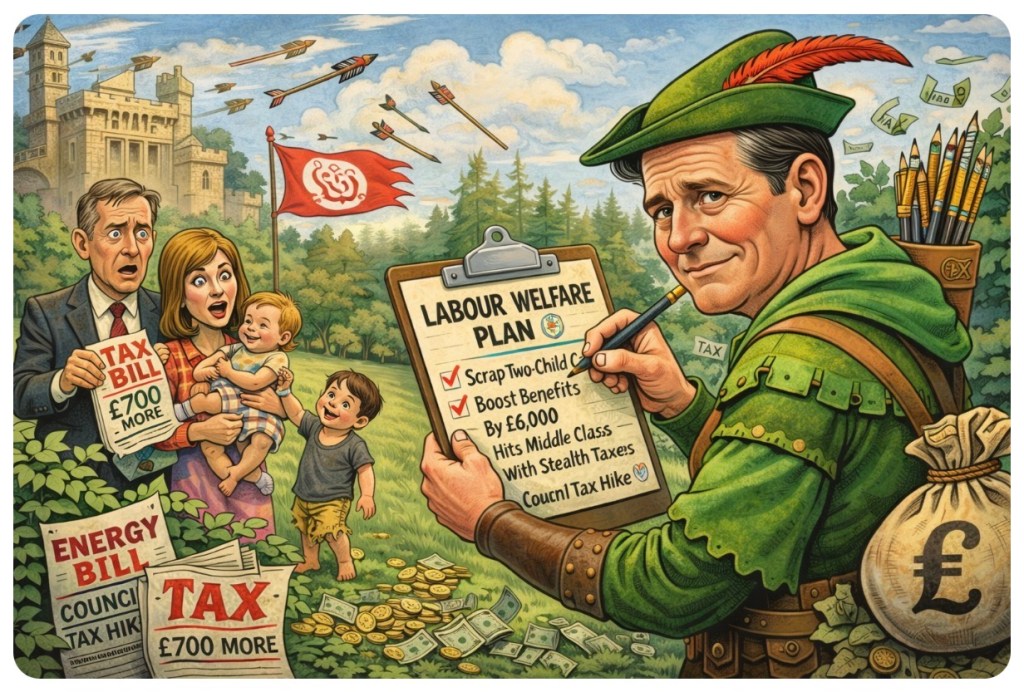
In today’s episode of “Policy Plot Twists,” the government is set to scrap the two-child cap—unlocking up to £6,000 a year for some households with no working parents. Meanwhile, millions of working families are bracing for higher council tax, rising bills, and stealth tax squeezes that quietly nibble away at pay packets.
Welcome to Britain, where the phrase “making work pay” is currently being workshopped. 🧪
💼 Robin Hood… But With a Spreadsheet
Under Keir Starmer’s leadership, pressure from backbenchers has turned into policy—lifting a cap that was originally designed to limit welfare expansion. On paper, it’s about reducing child poverty. In practice, it’s also about redistributing billions.
And who’s footing the bill?
Step forward the quietly bewildered middle:
- Council tax creeping up 📈
- Utility bills rising ⚡
- Income tax thresholds frozen (aka the stealth tax special)
All while Rachel Reeves works her fiscal magic—where nothing technically goes up, but somehow everything costs more.
⚖️ Incentives or Illusions?
Here’s where it gets spicy 🌶️
The core tension isn’t just about money—it’s about incentives.
Critics will say:
“Why graft, commute, and juggle childcare if the system increasingly cushions those who don’t?”
Supporters will counter:
“Children shouldn’t suffer because of their parents’ circumstances.”
Both arguments land. That’s the problem.
Because when policy tries to balance compassion with economics, it often ends up pleasing no one—and confusing everyone.
🪙 The Optics Problem (Again)
Let’s be brutally honest:
Even if the intention is noble, the optics are dynamite.
Working households see:
- Their costs rising
- Their tax burden increasing
- And others receiving a significant boost
And the immediate reaction isn’t nuanced economic debate—it’s:
“Hang on… how does this make sense?”
That perception—fair or not—is where governments win or lose trust.
🔥
Challenges
🔥
So here’s the question no policy paper can dodge:
Is this a necessary step to tackle poverty…
or a system that risks punishing work while rewarding dependency?
And more importantly—who decides where fairness actually sits?
💬 Take it to the blog comments. Don’t hold back—this one’s got opinions written all over it.
👇 Like, share, and drop your take below.
The most insightful (and most explosive) comments will be featured in the next issue. 📝🔥


 Chameleon Magazine
Leave a comment