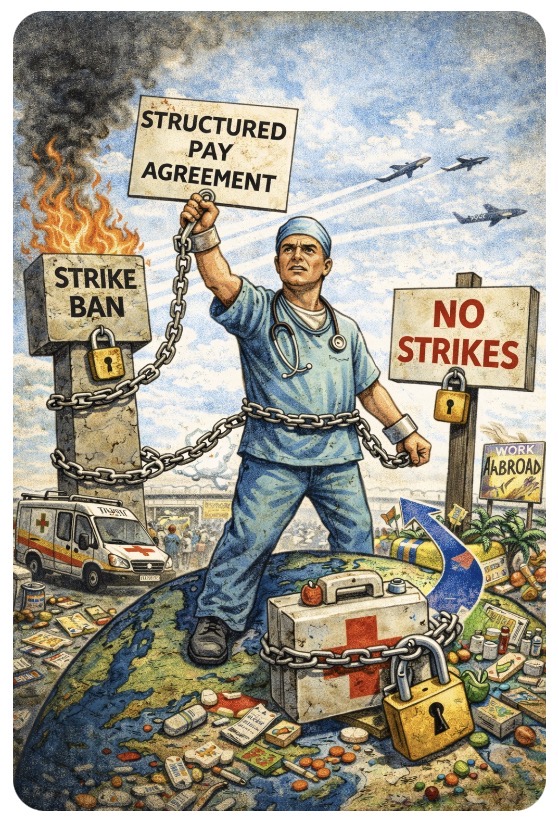
🏥⛔💷At some point, the endless cycle of strikes, negotiations, and disruption stops looking like a system under pressure—and starts looking like a system without a backbone.
Because if we’re serious about having a national health service, then it needs to be run like one—not like an ongoing dispute waiting to erupt every 18 months.
🧱 Build It Properly—Then Lock It In
The solution isn’t complicated—it just requires commitment.
Set a clear, independent pay structure:
- Linked to inflation 📊
- Adjusted for experience and responsibility 🩺
- Reviewed automatically at fixed intervals ⏱️
No political games. No delays. No last-minute brinkmanship.
Once that structure is in place—transparent, fair, and consistent—then it gets locked. Not tweaked every time pressure mounts. Not rewritten depending on who’s in power.
Locked.
Because certainty works both ways:
- Doctors know where they stand 💼
- The public knows what they’re getting 🏥
🚫 National Service Means National Responsibility
Here’s the hard edge of the argument.
If you’re part of a national health service, providing an essential, life-critical function, then walking out shouldn’t be an option once a fair system is in place.
Because this isn’t just another job—it’s a public service people rely on when everything else has gone wrong.
And yes, that comes with responsibility.
So the trade-off becomes clear:
- You get a fair, guaranteed, structured system 🤝
- In return, strike action is off the table 🚫
✈️ Don’t Like It? There Are Other Options
And here’s where it gets blunt.
If the system is fair, transparent, and stable—and someone still isn’t satisfied—then they have choices.
Other countries. Other systems. Other paths.
Because what you can’t have is:
- Guaranteed structure
- Guaranteed pay progression
- And the ability to shut the system down anyway
That’s not balance—that’s leverage without limits.
🎭 End the Cycle—or Keep Repeating It
Right now, we’re stuck in a loop:
Underpay → Frustration → Strikes → Panic → Short-term fix → Repeat 🔁
Your approach breaks that loop—but only if the first part is done properly.
Because if the structure isn’t genuinely fair, then banning strikes doesn’t solve the problem—it just buries it until it resurfaces in worse ways: staff shortages, burnout, and people leaving altogether.
So the real question isn’t just about banning strikes.
It’s this:
Can we build a system that’s fair enough to make them unnecessary—and strong enough to stand without them?
🔥 Challenges 🔥
Would you accept a no-strike NHS if pay was guaranteed and fair—or is the right to walk out essential no matter what? And if doctors start leaving instead of striking… are we better off or worse? 👀💬
👇 Hit comment, hit like, hit share. Lock it down—or leave it open?
The best comments will be featured in the next issue of the magazine. 🎯📝


 Chameleon Magazine
Leave a comment