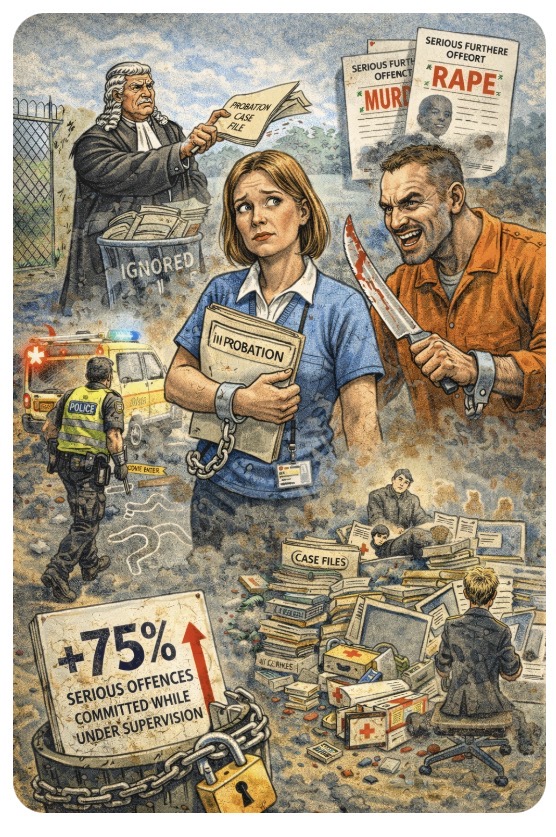
🚔📉⚖️A 75% rise in serious further offences—murders, rapes—committed by offenders already under supervision. Let that land for a second.
Because this isn’t just a statistic. It’s a system failing in real time.
And the question practically asks itself: how does something designed to prevent this end up enabling it?
🧑⚖️ When Risk Assessments Become Guesswork
Probation used to carry weight. Experience. Authority. Judgment forged over years dealing with people who don’t come with instruction manuals.
Now? We’re hearing about:
- Inexperienced officers thrown into high-risk cases
- Overloaded caseloads where “monitoring” becomes paperwork 📂
- Recommendations that judges increasingly ignore
That last one says everything.
If judges—who rely on these assessments—are starting to dismiss them, it’s not a small crack in the system… it’s a collapse in confidence.
Because what’s a risk assessment worth if no one trusts it?
🎭 The Illusion of Control
On paper, everything looks fine:
“Offender under supervision” ✅
“Conditions in place” ✅
“Risk managed” ✅
But reality tells a different story.
Because supervision without teeth isn’t supervision—it’s observation.
And observation doesn’t stop someone determined to reoffend.
It creates the illusion of control while the actual risk quietly builds in the background.
🧠 Naivety Meets Reality
There’s also an uncomfortable truth bubbling underneath all this.
Not every offender responds to support, guidance, or second chances in the way policy documents hope they will.
Some are manipulative. Some are dangerous. Some know exactly how to game a system that’s stretched too thin to challenge them properly.
And if the people overseeing them lack experience—or worse, confidence—then the balance tips fast.
From management… to missed warning signs.
From prevention… to reaction.
⚠️ When the System Goes Soft, the Consequences Go Hard
A 75% increase isn’t a blip. It’s a signal.
Something has shifted:
- Either standards have dropped
- Or pressure has broken the system
- Or both
Because when serious crimes are being committed during supervision, the problem isn’t just the offender.
It’s the system that said: “This is under control.”
🔥 Challenges 🔥
If supervision can’t prevent the worst outcomes, what’s it actually doing? Has the system become too stretched, too soft, or too disconnected from reality? And more importantly—how many warnings does it take before something changes? 👀💬
👇 Hit comment, hit like, hit share. Fix it, expose it, or challenge it.
The best comments will be featured in the next issue of the magazine. 🎯📝


 Chameleon Magazine
Leave a comment