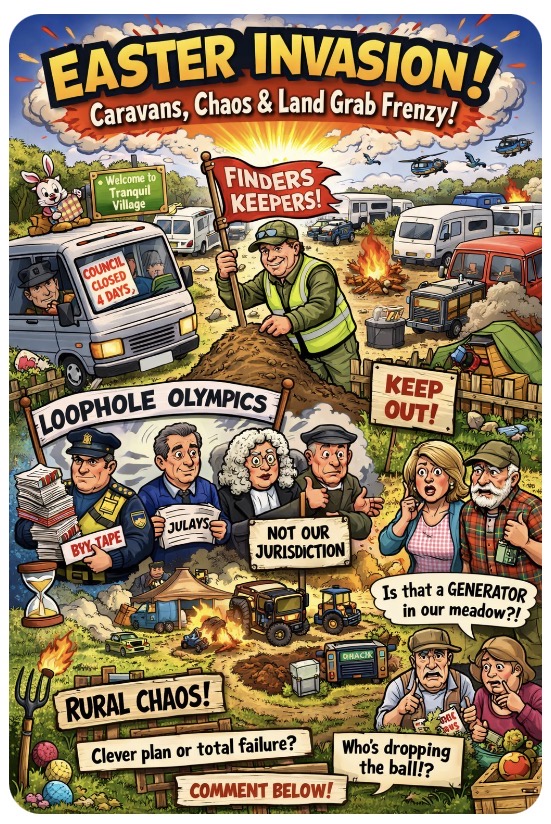
🐣🚐💥While most of Britain was busy overcooking lamb, arguing over chocolate egg hierarchies, and pretending four days off counts as a “holiday,” a far more ambitious group had other plans: seize land, outpace the law, and turn rural England into an impromptu festival of turf wars and tyre tracks.
Yes, while you were hunting for mini eggs, others were hunting for acreage—and winning.
🚨 Operation: “Finders Keepers, Councils Sleepers”
Picture the scene: convoys rolling in like it’s a low-budget military drill—except instead of tanks, it’s caravans; instead of camouflage, it’s high-vis and audacity. Over the Easter weekend, travellers reportedly coordinated rapid land occupations across rural areas, exploiting the exact moment when councils are skeleton-staffed and enforcement moves at the speed of a Sunday roast digestion.
It’s not just opportunistic—it’s strategic. Four days of bureaucratic paralysis equals prime time for setting up camp, digging in (sometimes literally), and making removal about as easy as evicting a cat from a sunbeam.
Residents? Less “quaint countryside calm,” more “what in the Mad Max is happening outside my kitchen window?”
There’s a particular kind of horror reserved for waking up to find your local green space has transformed overnight into a full-blown encampment—complete with generators humming like a dystopian lullaby and the creeping realisation that official help won’t arrive until after the chocolate eggs have expired.
🧠 The Great British Loophole Olympics
Let’s not pretend this is random chaos. This is a masterclass in timing.
Bank holiday? Check.
Reduced enforcement capacity? Check.
Legal grey areas thicker than gravy? Double check.
By the time authorities shuffle back into offices—half-asleep and mildly resentful—the land is occupied, the paperwork is a nightmare, and everyone’s suddenly speaking fluent “not our jurisdiction.”
Meanwhile, locals are left playing an involuntary game of “Guess Who’s Responsible?” while watching their fields morph into something between a campsite and a logistical standoff.
It raises an uncomfortable question: if the system can be gamed this easily, is it broken—or just politely pretending not to notice?
😬 Rural Britain: From Idyllic to “Is That a Generator?”
For residents, this isn’t just inconvenience—it’s disruption wrapped in uncertainty. Concerns over damage, noise, and safety bubble up fast, especially when the takeover feels sudden, coordinated, and unstoppable.
And yet, the response often feels like watching a slow-motion shrug. Legal processes drag. Evictions stall. Responsibility pinballs between agencies like a bureaucratic sport no one trained for.
The result? A countryside caught between tradition and tactical loopholes, where the only thing moving faster than caravans is public frustration.
🔥 Challenges 🔥
So here’s the real kicker: how does something this organised keep outpacing the very systems designed to manage it? Is this clever exploitation—or a glaring failure of governance? And more importantly… why does it keep working?
Got a take? A rant? A solution that doesn’t involve pitchforks (or does 👀)? Drop it in the blog comments—not just social media. Let’s hear it where it actually counts. 💬🔥
👇 Smash that comment button, share this with someone who still thinks bank holidays are “relaxing,” and let’s stir the pot.
The sharpest takes, wildest opinions, and most brutally honest comments will be featured in the next issue of the magazine. 🎯📝


 Chameleon Magazine
Leave a comment