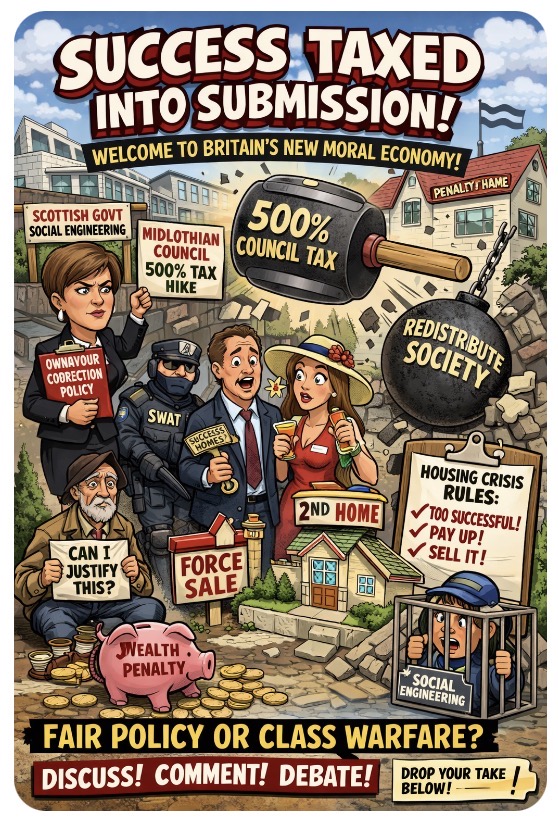
Apparently, owning more than one property now puts you somewhere between a Bond villain and a hoarder of oxygen. Thanks to policy moves enabled by the Scottish Government and rolled out by councils like Midlothian Council, you can now be slapped with council tax bills up to 500% higher—because clearly, your spare house is personally responsible for the housing crisis. 🫠
🚨 Congratulations, You’ve Achieved… Penalty Status
Let’s not sugar-coat it: this isn’t about bins, roads, or whether your streetlight flickers like a horror film prop. This is social engineering with a spreadsheet.
You didn’t suddenly start consuming:
- Six times the rubbish collection
- A private SWAT team of local police
- Gold-plated pothole repairs outside your driveway
No—what you did do is own something policymakers have decided should be used differently. And for that, you’re getting the financial equivalent of a public shaming bell 🔔
This is where the tone shifts from “tax system” to “behaviour correction device.”
You’re not being charged more because you take more.
You’re being charged more because you’re not behaving how the system wants you to.
And that’s a pretty big philosophical leap.
🧠 The Logic (Brace Yourself)
The argument goes something like this:
“Housing is scarce. You have more than one. Therefore, you are part of the problem.”
Elegant. Brutal. Politically convenient.
Never mind nuance like:
- Whether your second home is actually used frequently
- Whether you contribute to the local economy
- Whether you’re planning to retire there
- Whether the housing shortage is also driven by planning laws, supply constraints, or population shifts
Nope. The hammer only has one setting 🔨
🎭 The Real Debate: Fairness vs Control
Your instinct—“why pay more if I use less?”—comes from a clean, logical place: the user-pays principle.
But this policy lives in a different universe entirely:
- Housing = public good
- Ownership patterns = subject to correction
- Tax = lever to force redistribution
So the question isn’t:
“Is this fair based on usage?”
It’s:
“Do we accept financial pressure as a tool to reshape society?”
And that’s where it gets spicy 🌶️
🪙 When “Success” Becomes Suspicious
Here’s the uncomfortable undercurrent:
When policy starts targeting outcomes rather than actions, it can feel like success itself is being reframed as something that needs managing—or worse, suppressing.
Not because success is illegal…
…but because it’s inconvenient to a broader system goal.
That doesn’t automatically make the policy wrong—but it does explain why it feels wrong to a lot of people.
Because it flips the script from:
- “You earned this”
to - “You need to justify this”
🔥 Challenges 🔥
So where do you land? Is this smart housing policy… or economic micromanagement dressed up as fairness?
Should governments be allowed to financially pressure people into behaving differently with what they own? Or is this a slippery slope where today it’s second homes… and tomorrow it’s “underused” anything?
Drop your take directly in the blog comments—not just a scroll-by reaction. Let’s see who defends it, who tears it apart, and who’s quietly sweating over their spare key. 🔑🔥
👇 Comment. Like. Share. Stir the pot.
The sharpest takes (and the most savage ones) will be featured in the next issue. 📝🎯


 Chameleon Magazine
Leave a comment