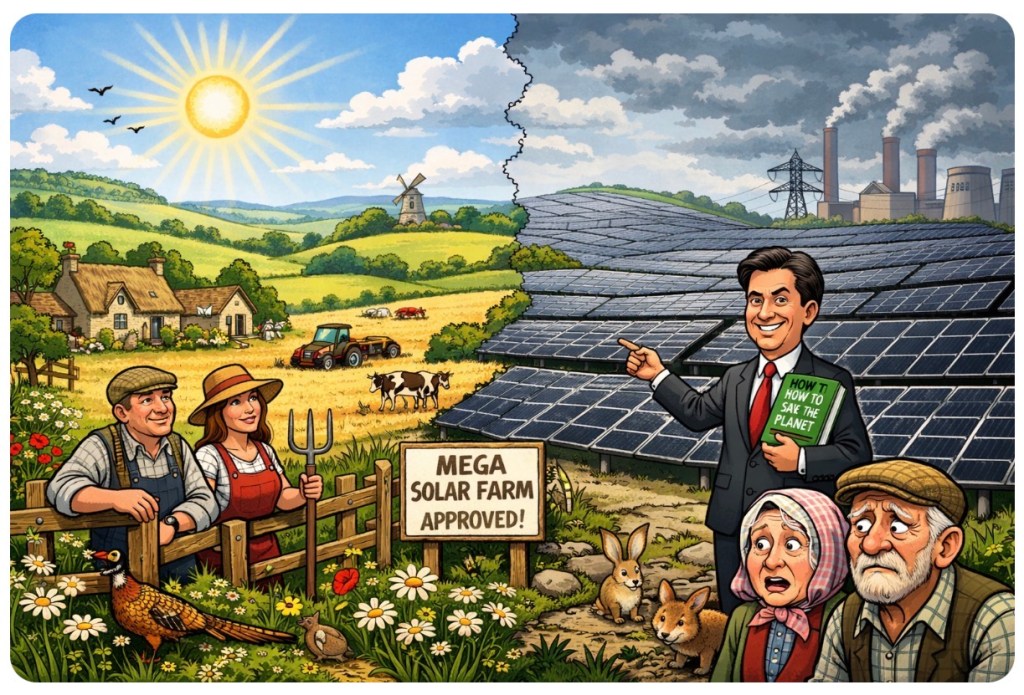
Britain’s countryside just got a new landlord—and apparently, it doesn’t care much for tenant opinions. Ed Miliband has waved through plans for the UK’s largest solar farm, brushing aside local objections like crumbs off a Westminster lunch table. Residents in Lincolnshire say it will transform the “very nature” of their home. Miliband seems to think that nature just needs… upgrading. Preferably with panels.
🌾 “Don’t Worry, Little Villagers — I’ve Read Books” 📚
Ah yes, the age-old tradition of democracy: listening carefully… then doing the exact opposite. Locals raise concerns about landscape destruction, environmental impact, and—minor detail—their entire way of life. Meanwhile, somewhere in a well-lit office, a man with a policy paper and a latte decides they simply don’t get it.
Because clearly, centuries of living, farming, and surviving on the land pale in comparison to a PowerPoint presentation titled “Sun Good, Complaints Bad.”
The implication that rural communities lack the “education” to understand what’s best for them? Bold strategy. Nothing wins hearts and minds like telling people they’re too dim to recognize progress when it’s bolted across their horizon.
Of course, this isn’t just about solar panels. It’s about a creeping philosophy that “net zero” must come with zero resistance—preferably by redefining resistance as ignorance. Who needs consent when you’ve got conviction?
And let’s not pretend this is purely green utopia. For many residents, it feels less like saving the planet and more like sacrificing their backyard so someone else can tick a target box. 🌍✔️
🔥 Challenges 🔥
If progress means bulldozing dissent, is it really progress—or just polished arrogance? Would you accept your hometown being transformed against your will “for your own good”? Or is this the moment where green ambition starts looking a little… grey?
💬 Drop your thoughts directly on the blog—are locals being ignored, or is this the price of a cleaner future?
👇 Hit comment, hit like, hit share. Bring the heat (solar-powered, naturally).
The sharpest takes will be featured in the next issue of the magazine. 🎯📝


 Chameleon Magazine
Leave a comment