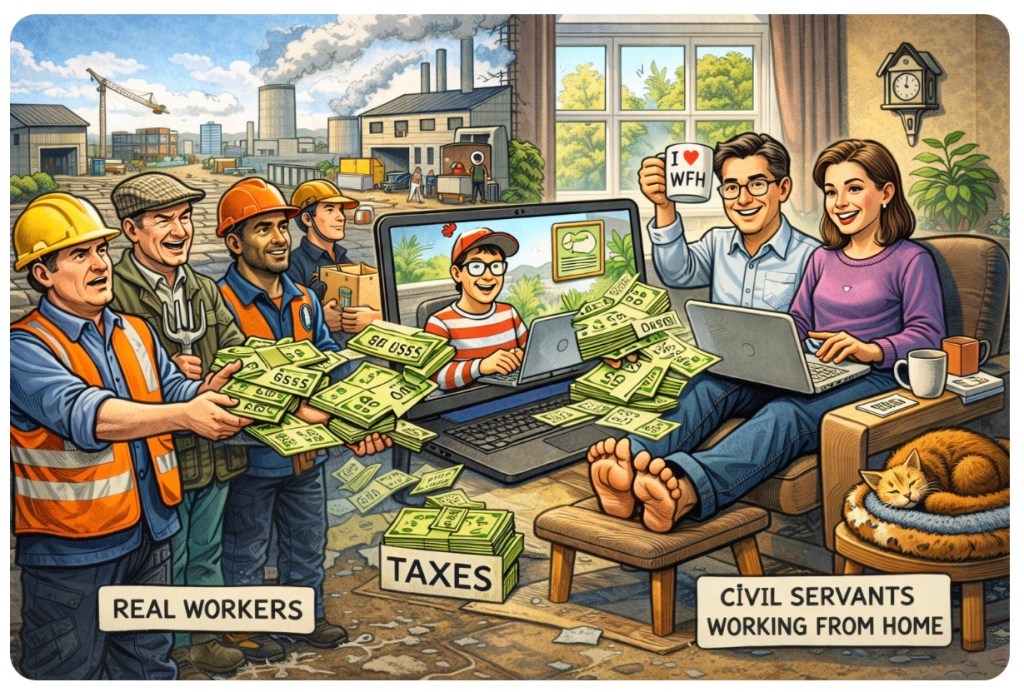
While millions clock in at warehouses, construction sites, and factory floors—rain, wind or relentless supervisors—another corner of the workforce has secured a different kind of victory: the commute from bed to laptop.
The Office for National Statistics has lost its push to bring staff back into offices, meaning many civil servants can now continue working from home… indefinitely.
🛋️ Productivity or Pyjama Policy? ☕
For some, this is progress. Flexible working, better work-life balance, fewer packed trains, and—let’s be honest—meetings where “You’re on mute” becomes a national anthem.
But for others, it lands like a slap with a soft cushion.
Because while one group debates Teams backgrounds and optimal coffee angles, another is hauling pallets, pouring concrete, harvesting crops, or keeping production lines alive—jobs where “working from home” is about as realistic as Zooming in from a forklift.
And here’s where the tension bubbles up:
Those funding public sector salaries through taxes often don’t get the same perks. No duvet-adjacent desk. No midday laundry cycle disguised as “admin.” Just alarms, shifts, and showing up—physically.
So when civil servants secure the right to stay home, it raises an uncomfortable question:
Is this a fair evolution of work… or a two-tier system quietly hardening in plain sight?
Of course, not all office work needs a desk in a building. And not all home workers are slacking—many are just as productive (sometimes more). But perception matters. And right now, the optics look like:
One Britain commuting. One Britain connecting.
🔥 Challenges 🔥
Is working from home a modern necessity—or a growing divide between those who can and those who can’t? Should flexibility depend on the job… or should everyone share the same expectations?
💬 Take it to the blog—are you logging in from home, or clocking in on site? Who’s got it right?
👇 Like, share, and drop your take below. No filters, no fluff.
The best comments will be featured in the next issue of the magazine. 🎯📝


 Chameleon Magazine
Leave a comment