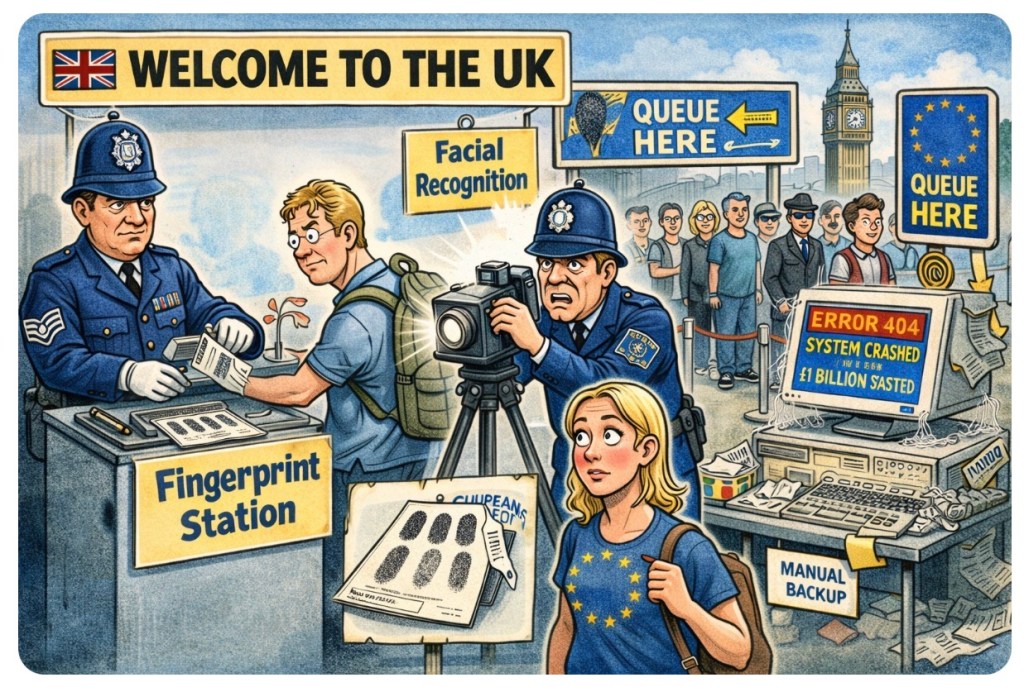
So Europe wants your fingerprints, your face scan, and possibly your soul before letting you past baggage reclaim—and Britain’s response? A firm cup of tea and a strongly worded sigh.
But why stop there? If we’re playing the “prove you’re human before you sunbathe” game, why isn’t the UK jumping on the same bureaucratic merry-go-round? Why not give European visitors the full authentic British experience: a queue, a clipboard, and a slightly grumpy bloke named Dave taking your fingerprints with ink like it’s 1973? 🖋️😐
Because if there’s one thing Britain excels at, it’s not rushing into shiny digital systems that cost a billion pounds and then collapse faster than a deckchair in a hurricane.
🧾 Analog Britain Strikes Back: Ink Pads, Flashbulbs & Mild Disappointment
Forget sleek biometric scanners and futuristic gates. In this version of Britain, you land at Heathrow and are greeted not by cutting-edge tech—but by a folding table, a Polaroid camera, and a queue that appears to bend the laws of physics.
“Next!” shouts Dave, as he aggressively rolls your fingers in ink like you’ve just been arrested for stealing a Tesco meal deal.
Smile for the camera? No need. The flash goes off before you’ve even realised what’s happening. Your photo emerges slowly, capturing you mid-blink, mid-confusion, mid-existential crisis. Perfect for the records. 📷
And the system? Oh, it’s foolproof. Everything is stored in a filing cabinet labelled “EU People – Probably.” Need to find someone? Just dig through 14,000 smudged fingerprints and hope for the best.
Meanwhile, somewhere in the background, a £1 billion digital system sits “under development”—which is British code for “we lost the password and Gary from IT retired in 2019.” 💻🔥
💷 A Billion Pounds Later… Still Using Sellotape
Let’s be honest. If Britain did try to build a high-tech biometric entry system, it would:
- Launch three years late
- Cost double the original budget
- Crash on day one
- And require a manual backup involving laminated forms and a biro chained to a desk
Because nothing says “global superpower” like rebooting a border control system while passengers form a queue long enough to qualify as a landmark.
So maybe the low-tech route isn’t incompetence—it’s strategy. Why build a system that fails digitally when you can fail consistently with paper?
And let’s not forget: at least with Dave and his ink pad, you get a bit of human interaction. Sure, it’s mildly hostile and smells faintly of biscuits—but it’s authentic.
🔥 Challenges 🔥
Would you trust Britain with a billion-pound biometric system… or a man named Dave with an ink pad? 🤔
Is high-tech surveillance better than low-tech chaos—or are they just two sides of the same expensive coin?
And here’s the kicker: if both systems are a mess… why are we paying for either?
Drop your thoughts in the blog comments—sarcasm, outrage, or dry British despair all welcome. 💬🔥
👇 Like, share, and tell us—would you rather be scanned by a machine or processed by Dave?
The best (and most brutal) comments will be featured in our next magazine issue. 🎯📝


 Chameleon Magazine
Leave a comment