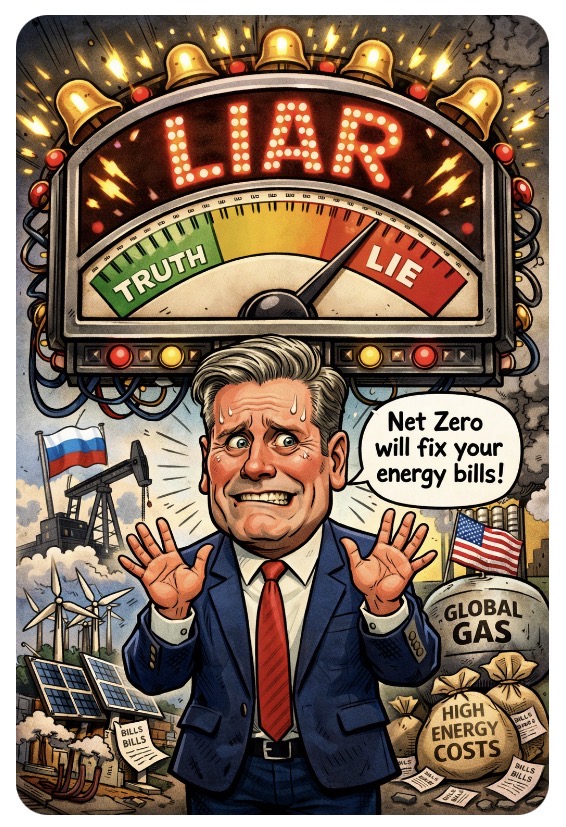
Keir Starmer says high energy prices are being driven by global markets—pointing the finger at countries like Russia and the United States—and that the answer is to push harder toward Net Zero.
On the surface, that sounds reasonable.
Global markets do push prices up. Wars, supply shocks, and international demand all feed into what we pay at home. That part isn’t the issue.
The problem is what comes next.
Because the argument quietly jumps from:
“global markets are the problem”
to
“Net Zero is the solution.”
And that only works if Net Zero actually breaks our link to those global markets.
It doesn’t. Not on its own.
The UK doesn’t just have an energy supply system—it has a pricing system. And that system is still wired directly into global gas prices.
Even if we build more wind, more solar, more nuclear—electricity prices are still set by the most expensive energy needed at any moment. And right now, that’s usually gas.
Gas that is traded globally.
Gas that we don’t control.
Gas that sets the price for everything else.
So you can have cheap renewable energy being generated across the country—and still end up paying high prices because gas sets the benchmark.
That’s the part that gets left out.
Green energy changes where energy comes from.
It does not automatically change how energy is priced.
So if the system stays the same, then the link to global markets stays the same.
Which means the public is being told one thing while living another.
If the real goal is to escape global price shocks, then the focus shouldn’t just be on generation. It should be on reforming the system itself—breaking the mechanism that ties domestic prices to international gas markets.
Because without that, nothing fundamental changes.
You’re not stepping off the rollercoaster.
You’re just painting it green.
And that leaves a simple choice:
Either unravel the link to global pricing,
or stop pretending that changing the energy source will do it for you.


 Chameleon Magazine
Leave a comment