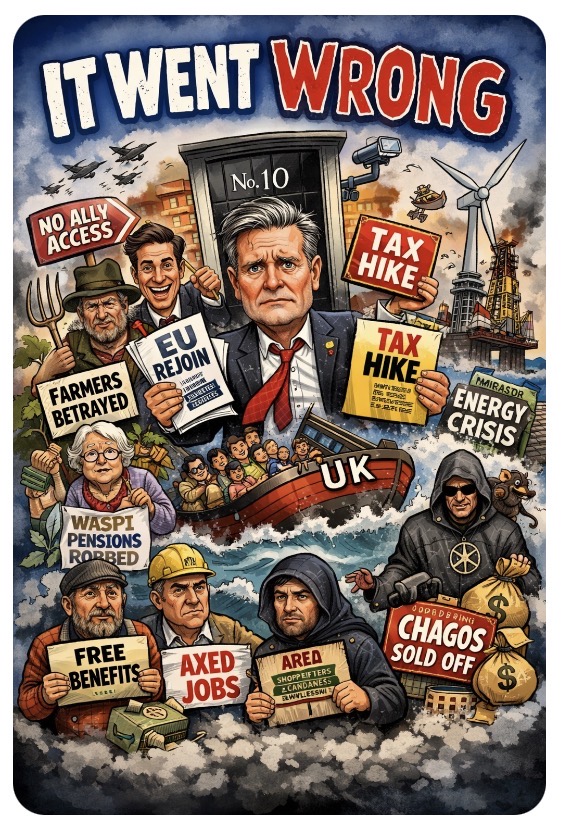
From the moment the door of Number 10 closed behind him, the direction was set. What followed wasn’t one mistake—but a pattern. A sequence of decisions that, taken together, built a narrative of frustration, division, and growing distrust.
🚨 The Full Breakdown: Where It Went Wrong and Why
It went wrong when Keir Starmer entered No. 10
Because expectations were high, and the early signals suggested a disconnect between leadership priorities and public concerns.
It went wrong when he decided to erase our national identity
Because changes to cultural messaging and policy direction made people feel that traditional values were being sidelined.
It went wrong when he tried to get us back into the EU
Because it reignited divisions many believed had already been settled, reopening political and social fractures.
It went wrong when he put in place a two-tier judicial system
Because people were being judged unfairly and not in line with the laws of our country.
It went wrong when he welcomed a tidal wave of illegal immigrants
Because pressure on housing, healthcare, and services reinforced the belief that borders were not being effectively controlled and everyone else had to pay.
It went wrong when he made shoplifting illegal
Because enforcement approaches were viewed as uneven, leading to confusion over priorities and justice.
It went wrong when he forced cultural enforcement
Because policies were imposing viewpoints rather than allowing open debate, creating resistance.
It went wrong when he betrayed our farmers
Because agricultural decisions and trade pressures made farmers feel unsupported and economically vulnerable.
It went wrong when he failed WASPI women
Because long-standing pension concerns remained unresolved, deepening frustration among those affected after telling them he would support them.
It went wrong when he failed the pedophile rings
Because failures in justice and accountability led to anger over the protection of victims and punishment of offenders.
It went wrong when those who don’t want to work get more than the people who do
Because welfare perceptions created a sense of imbalance between effort and reward.
It went wrong when he decided we weren’t paying enough taxes and brought in Net Zero taxes
Because rising financial pressure on households and businesses increased dissatisfaction during a cost-of-living strain.
It went wrong when he refused our main ally access to bases
Because it raised concerns about weakening strategic relationships and national security.
It went wrong when he removed the heating allowance
As if old people don’t need heating to survive let’s make it harder.
It went wrong when he sold the Chagos Islands for billions
Because it was viewed as giving up sovereign territory and raised questions about national interest.
It went wrong when he gave a job to the “lord of darkness”
Because controversial appointments created distrust and fueled negative public perception and he was friends with a convicted pedophile.
It went wrong when he allowed Ed Miliband to stop us drilling
Because energy decisions increased fears over costs, supply security, and economic impact and like fools we are now buying from everyone else.
It went wrong when he rushed out to the Middle East to appear part of a peace deal
Because it was seen as political positioning rather than meaningful diplomacy.
This isn’t just about one policy or one decision—it’s the accumulation effect. When people feel that missteps keep piling up, the narrative shifts from “he should do better” to “he shouldn’t be there at all.”
The word “incompetent” doesn’t get thrown around lightly—it reflects a total collapse of confidence. And once that label sticks in the public mind, it’s incredibly difficult to shake.
But here’s the reality: in the UK system, removal isn’t driven by how strongly people feel—it’s driven by process. Whether through Parliament, the Labour Party, or ultimately the voters, change only happens when those mechanisms are triggered.
So the tension builds—public anger on one side, political procedure on the other.
And that gap? That’s where debates like this explode.
It’s now time to remove him before he does anymore damage.
🔥 Challenges 🔥
How many of these hit home for you? Which one crossed the line from concern to outright frustration? This isn’t just a list—it’s a reflection of what people are feeling but not always saying out loud.


 Chameleon Magazine
Leave a comment