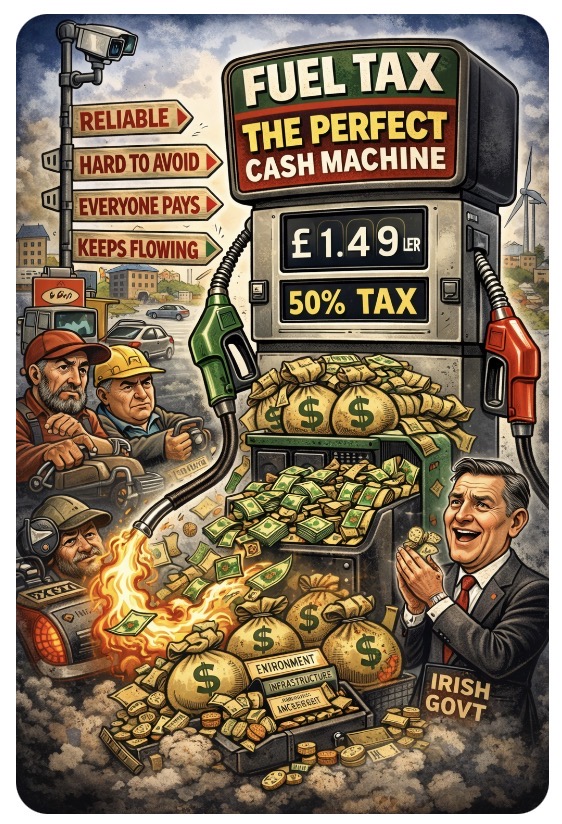
Let’s flip it—no outrage, no hesitation—just the cold, hard logic:
If you wanted to design the perfect system to raise money, you’d struggle to beat taxing fuel.
🎯 Why Fuel Tax Is the Ultimate Revenue Weapon
Fuel isn’t a luxury. It’s not optional. It’s not something people can easily cut out.
That’s exactly why it works.
- 🚗 Everyone uses it – workers, businesses, deliveries, emergency services
- 🔁 Constant demand – people don’t stop driving because prices go up
- 💳 Paid daily – not once a year like income tax, but every single fill-up
- 📍 Hard to avoid – you can’t offshore your petrol tank or hide it in a tax haven
If you’re a government looking for steady, predictable income, this is gold.
💰 It’s Not Just a Tax—It’s a Stream
Unlike other taxes that fluctuate:
- Income tax depends on employment
- Corporate tax depends on profits
- Property tax depends on markets
Fuel tax?
👉 It just keeps flowing.
Rain, shine, recession, boom—people still need to move.
⚙️ Built-In Advantage: People Absorb It
Here’s the brutal genius of it:
Instead of one big visible bill…
it’s small, repeated hits.
- £10 here
- £20 there
- Every week
It blends into life. People complain—but they still pay.
🌍 Bonus Justification Layer
On top of that, governments get a perfect narrative:
- “It’s for the environment” 🌱
- “It reduces emissions” 🌍
- “It funds infrastructure” 🛣️
So not only does it raise money—it comes with built-in public justification.
🧠 The Strategic Reality
If you step back and look at it purely as a system:
👉 It’s one of the most efficient, hardest-to-avoid, consistently profitable taxes ever created.
Which is exactly why it’s so heavily relied on.
Or is it too effective to ever let go?
Be honest—logic over emotion.
👇 Drop your take: Is fuel tax smart policy… or just smart exploitation?
Best comments land in the next issue. 🎯📝


 Chameleon Magazine
Leave a comment