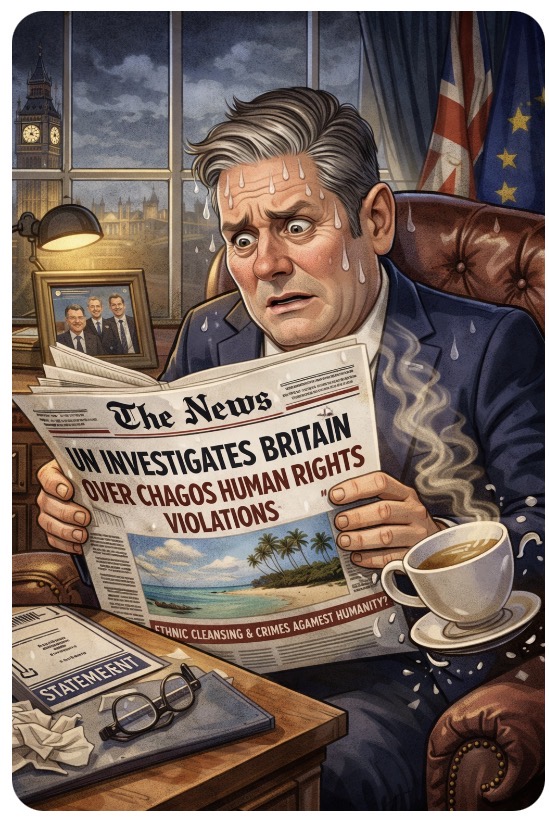
⚖️🏝️The ghosts of empire have entered the courtroom, and this time they’re not asking politely. The United Nations is now circling Britain’s handling of the Chagos Archipelago, with accusations flying that sound less like policy disagreements and more like the trailer for a legal apocalypse: “ethnic cleansing”… “crimes against humanity.”
And somewhere in Westminster, Keir Starmer is staring at a briefing note like it just personally insulted him at a dinner party. 🍷😬
🏛️ From Colonial Footnote to Legal Grenade
For decades, the forced removal of Chagossians was treated like one of those awkward historical footnotes Britain prefers to keep buried under layers of polite silence and diplomatic tea. ☕
Now? It’s back—with lawyers, headlines, and the kind of language that makes governments reach for the emergency “this is complex” button.
The allegation is simple, brutal, and deeply inconvenient: that the expulsion of islanders to make way for military use wasn’t just controversial—it may have crossed into the territory of serious human rights violations.
Suddenly, this isn’t history. It’s liability.
😬 The Political Tightrope (Featuring Very Slippery Shoes)
Here’s where things get deliciously uncomfortable.
On one side: international law, human rights scrutiny, and the looming glare of global opinion.
On the other: alliances, military arrangements, and decades of “let’s not poke that particular bear.”
And right in the middle? Starmer—trying to look principled without detonating diplomatic relationships faster than you can say “legacy issue.”
Because let’s be honest: nothing rattles a modern British leader quite like the possibility of looking out of step with European peers while simultaneously being dragged into a moral reckoning with the past. 🇪🇺👀
It’s less “boots shaking” and more “carefully measured public statements while internally screaming into a very expensive cushion.”
🎭 Damage Control, But Make It Statesmanlike
Expect phrases like:
- “We take these allegations seriously”
- “A thorough review is underway”
- “We remain committed to international law”
Translation?
“We would very much like this to not become a full-blown geopolitical embarrassment.”
Because if there’s one thing worse than a scandal, it’s a scandal with archival receipts, living victims, and the United Nations asking follow-up questions.
🔥 Challenges🔥
Here’s the real kicker: how long can a nation balance moral leadership with unresolved history before the scales snap? ⚖️
Is this overdue justice—or a politically inconvenient reopening of the past?
Drop your take directly on the blog—no fence-sitting allowed. Are we witnessing accountability… or selective outrage with a UN logo slapped on it? 💬🔥
👇 Hit comment, hit like, hit share—bring the heat, bring the facts, bring the sarcasm.
The sharpest takes will be featured in the next issue of the magazine. 🎯📝


 Chameleon Magazine
Leave a comment