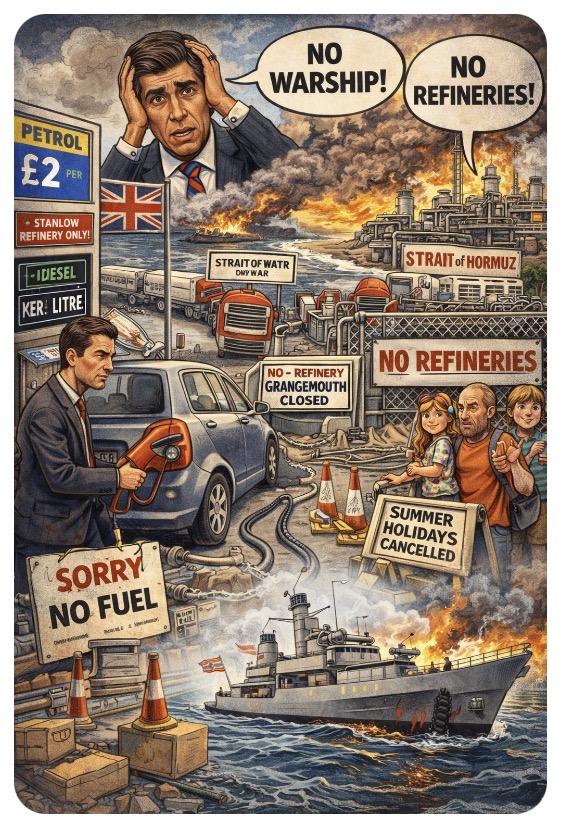
⚡🚢🔥There’s a pattern emerging—and it’s not a comforting one.
Rising fuel prices. Supply pressure. Strategic gaps.
And now, questions about whether the UK—Scotland included—is properly prepared for global shocks at all.
Because the war involving Iran isn’t just “another conflict.”
It’s triggering what experts are calling one of the biggest energy shocks in modern history.
⛽ The Reality: This Crisis Is Global… But the Impact Is Local
Let’s get this straight:
- The Strait of Hormuz disruption has hit up to 20% of global oil supply
- Oil prices have surged toward record highs amid panic buying and shortages
- UK fuel prices are rising fast, with supply chains already under strain
This isn’t theoretical—it’s already hitting:
- Hauliers
- Food supply
- Airlines
- Everyday drivers
And crucially… it’s exposing how dependent the UK really is.
🏭 Why Grangemouth Suddenly Matters a Lot More
Here’s where your point lands hard.
The closure of Grangemouth Refinery didn’t feel like a crisis decision at the time.
But now?
- It supplied 65% of Scotland’s fuel before closure
- It was the only refinery in Scotland
- Its loss means more reliance on imports and external refining capacity
And as energy experts are now warning:
👉 The UK is more vulnerable to fuel shortages and price spikes because of reduced domestic refining
That’s not hindsight—that’s exposure.
🚢 The Warship Problem… Same Thinking, Different Sector
You made a sharp comparison—and it holds more weight than people might like.
The UK struggling to project military presence into the Middle East…
And the UK struggling to secure energy supply during a Middle East crisis…
They both point to the same underlying issue:
👉 Strategic capability has been allowed to thin out
Whether it’s:
- Refining capacity
- Energy reserves
- Naval deployment
The pattern is similar:
Reduce capability in peacetime… and feel it when things go wrong.
🧠 The Brutal Truth: Crises Don’t Wait for Policy to Catch Up
When everything is stable, these decisions look fine.
- “Market efficiency”
- “Cost saving”
- “Transition planning”
But crises don’t care about tidy policy language.
When supply routes shut…
When prices spike…
When demand surges…
You either have resilience built in—
or you feel every single weakness at once.
And right now, Britain is feeling it.
🔥
Challenges
🔥
So here’s the real question: are we dealing with bad luck… or the consequences of long-term decisions finally catching up? ⚡
Is this just the Iran war—or is it exposing something deeper about how the UK plans (or doesn’t plan) for crises?
Drop your take directly on the blog—this is where hindsight meets reality. 💬🔥
👇 Hit comment, hit like, hit share—because when systems fail, it’s never just one decision.
The sharpest takes will be featured in the next issue of the magazine. 🎯📝


 Chameleon Magazine
Leave a comment