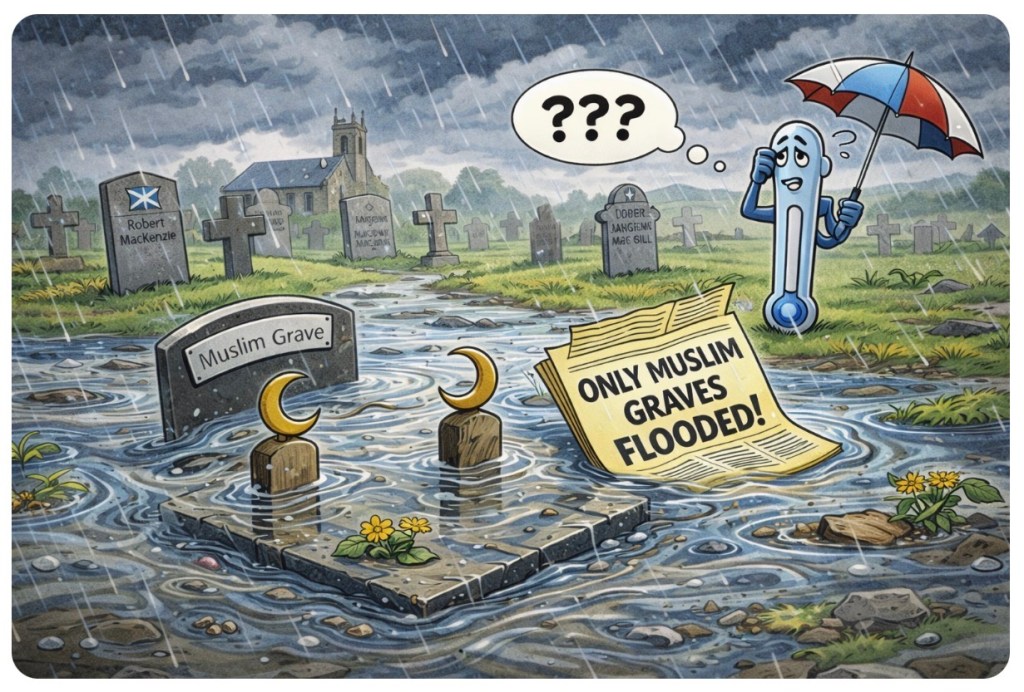
Muslim graves in a Scottish cemetery have been flooded, leaving families unable to install headstones. A straightforward story about severe weather—until the headline starts nudging people toward a very different conclusion.
📰 “Muslim Graves Wrecked…” — And Suddenly the Sky Looks Suspicious
Here’s where it gets interesting.
The moment you single out “Muslim graves” in a headline, it naturally makes people pause and think:
“Why just them?”
“Why not others?”
“Is something else going on?” 🤔
And just like that—boom—the rain has gone from background nuisance to prime suspect.
But strip it all back, and what are we actually dealing with?
British weather.
Heavy rain.
Waterlogged ground.
That’s it.
No hidden agenda.
No selective targeting.
No deeper plot.
Just the same chaotic, relentless, tea-soaking, plan-ruining British weather that floods roads, cancels trains, and turns gardens into lakes without so much as a warning. 🌧️🚧
The rain didn’t check a map.
It didn’t read a headline.
It didn’t make a decision.
It just showed up—uninvited, unbothered, and completely out of control, as always.
But the headline? That’s where things take a turn.
Because once you frame it a certain way, people start connecting dots that were never there—turning a basic weather story into something that feels loaded, deliberate, even suspicious.
When in reality, the only thing responsible is the same force that’s been ruining British summers since the beginning of time:
The weather. ☁️👑
🔥 Challenges 🔥
So here’s the real question: how much power does a headline actually have over what we think we’re seeing?
Are we reacting to rain… or to the way it’s being presented? And how often are we nudged into asking the wrong questions entirely? 💬🌧️
👇 Drop your thoughts in the blog comments—not just on socials.
Like it, share it, and tell us: is this just bad weather… or headline wizardry at work? 📰⚡
The best comments will be featured in the next issue of the magazine. 🎯🔥


 Chameleon Magazine
Leave a comment