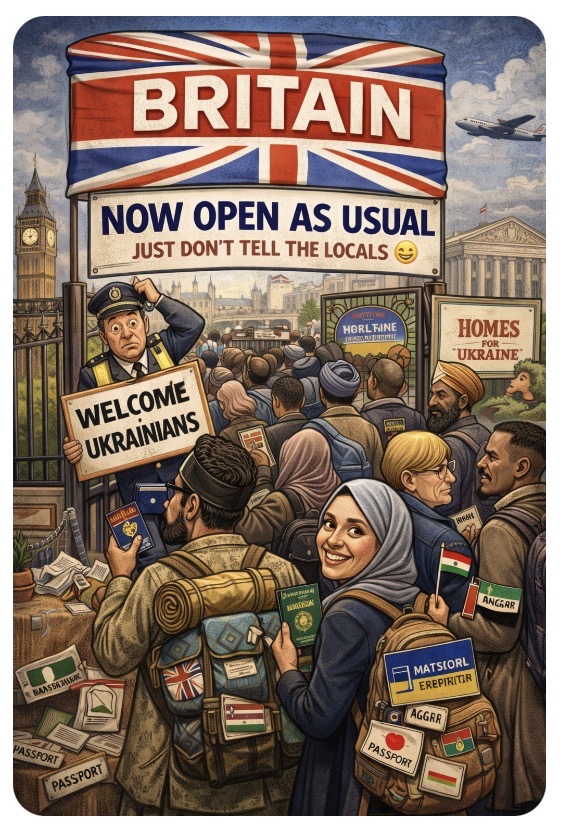
🇬🇧🛂😬In a move designed to offer sanctuary to those fleeing war, the UK opened its doors under schemes for Ukrainians escaping Vladimir Putin’s invasion.
But now, headlines suggest something far messier: a system stretched, tested—and arguably gamed—through family links that extend far beyond Ukraine itself.
🎭 The Fine Print That Did the Heavy Lifting
Let’s be clear—this wasn’t a secret backdoor. It was written into the rules.
The visa schemes allowed family members of Ukrainians to apply. And “family,” in immigration terms, can stretch wider than people expect—spouses, dependents, extended relations.
So when applicants from countries like Afghanistan, Nigeria, Iraq, or India appear in the data, it’s not necessarily a breach—it’s the system working exactly as designed… just not as many imagined.
And that’s where the frustration kicks in.
🧠 Policy vs Reality: A Very British Gap
On paper:
A humanitarian route for Ukrainians fleeing war.
In practice:
A global patchwork of applicants connected through family ties, landing in Britain under a scheme most assumed was narrowly focused.
This is the classic policy blind spot—
Not illegal.
Not hidden.
Just… not fully thought through in terms of public perception or scale.
And once numbers start circulating—“112 countries,” “thousands of visas”—the narrative writes itself.
🏛️ Loophole or Design Feature?
Here’s the uncomfortable bit:
Calling it a “loophole” suggests something accidental.
But this looks more like a deliberate trade-off—flexibility vs control.
You either:
- Keep rules tight and exclude legitimate family members
- Or widen them and accept complexity (and criticism)
Britain chose the latter.
The real issue isn’t that the system was “missed”—it’s that it was built with elasticity, and now people are noticing how far it stretches.
🔥 Challenges🔥
So what’s the real problem here: the policy… or the expectations around it? 🤔
Should humanitarian schemes be tightly restricted—or flexible enough to include wider family networks, even if it sparks backlash?
Drop your take directly on the blog—no slogans, just straight opinions. Is this compassion… or careless design? 💬🔥
👇 Hit comment, hit like, hit share—this one’s guaranteed to divide the room.
The sharpest takes will be featured in the next issue of the magazine. 🎯📝


 Chameleon Magazine
Leave a comment