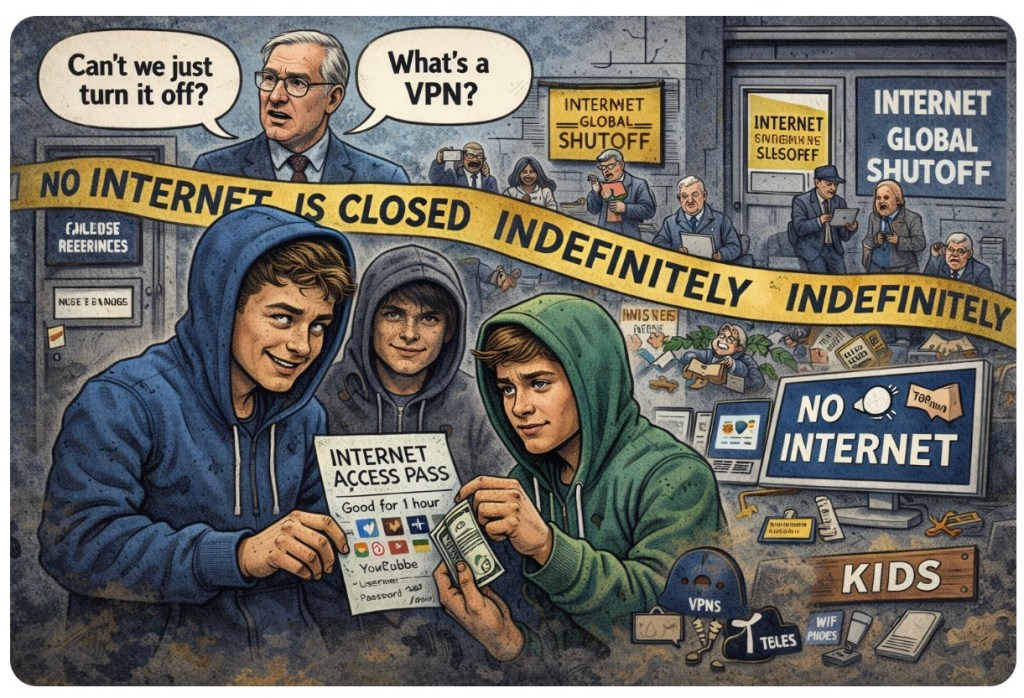
Australia tried to slam the digital door shut on kids… and the kids promptly found the window, the back gate, and probably a secret tunnel under the fence. Because if there’s one thing more predictable than teenagers wanting Wi-Fi, it’s their ability to outsmart rules written by people who still say “the Facebook.” 😏
🧠 Ctrl + Alt + Outplayed
The idea sounds noble on paper: protect children from the chaos of the internet. But in practice? It’s like trying to stop rain with a colander.
VPNs, burner accounts, borrowed devices—kids didn’t just bypass the restrictions, they turned it into a group project. Sharing tips like digital smugglers:
“Oi, use this app.”
“No, no, this one’s better—works on school Wi-Fi.”
Before you know it, you’ve accidentally created a generation of junior cybersecurity experts. 🎓💻
And now we arrive at the logical endgame of this thinking: if you really want to stop children accessing the internet… you’d have to switch it off. For everyone. Entirely. Globally. 🌍🔌
Brilliant. No emails, no banking, no businesses, no streaming—just millions of adults staring into the void while teenagers shrug and say, “Worth it.”
Because short of that? The internet isn’t a gate—it’s a hydra. Cut off one head, and three more apps pop up overnight.
And let’s not pretend the workaround economy wouldn’t explode overnight. You can already picture it:
teenagers whispering in corridors,
young adults trading access codes like backstage passes,
and a shadowy network of hoodie-wearing “Wi-Fi dealers” selling premium logins behind the bike sheds. 💸📲
“Got any TikTok?”
“Yeah—£5 for 30 minutes. No screenshots.”
Congratulations—you didn’t stop access. You created a black market.
🏛️ When Policy Meets Reality (And Loses Badly)
Let’s be brutally honest—this isn’t just a failure of enforcement, it’s a failure of understanding.
Technology moves fast. Culture moves faster. Legislation? That lumbers along like it’s still buffering on dial-up.
So you end up with rules written by people who don’t fully grasp the systems they’re regulating, aimed at users who grew up mastering those systems before they could legally cross the street.
It’s like trying to regulate Formula 1… with someone who’s only ever driven a mobility scooter. 🏎️💨
And sure, the intention might be protection—but poorly designed rules don’t protect. They just create loopholes, workarounds, and entire underground economies run by people who haven’t even sat their GCSEs yet.
Are we protecting kids—or just turning them into better rule-breakers? If the only “solution” is shutting down the entire internet, was the policy ever realistic to begin with?
💬 Drop your thoughts in the blog comments—have you seen kids outsmart tech rules like this? Or would you actually support stricter controls?
👇 Like, share, and tag someone who still thinks turning the router off solves everything.
The sharpest takes will be featured in the next issue of the magazine. 🎯📝


 Chameleon Magazine
Leave a comment