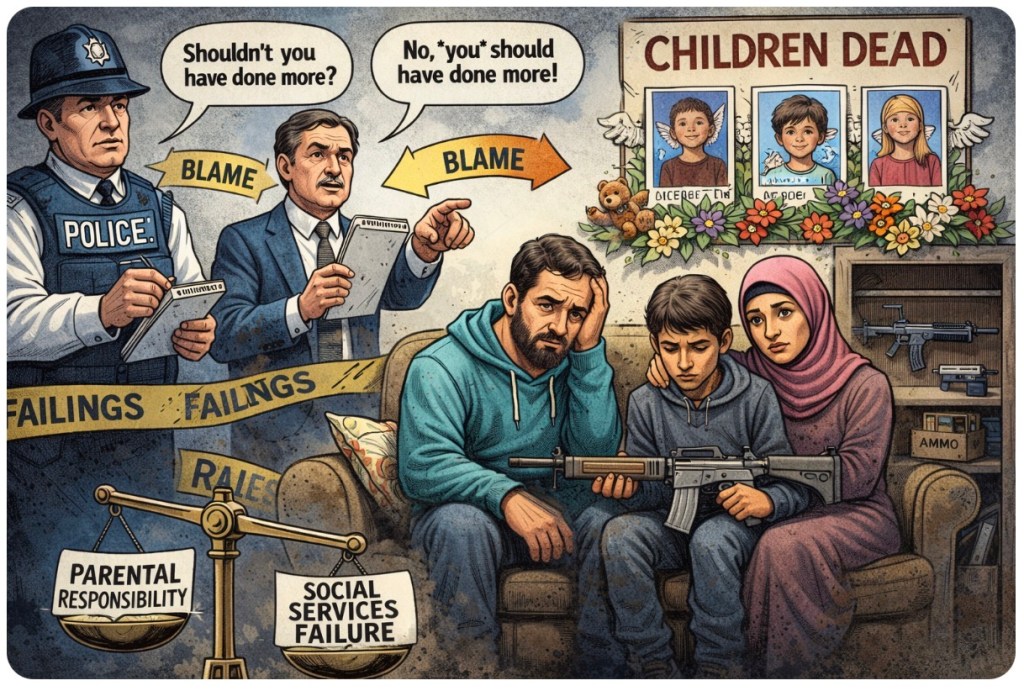
Another inquiry. Another panel. Another round of officials “digging deep” to uncover what—let’s be honest—most people already suspect: systems failed, warnings were missed, and responsibility somehow evaporated into thin air.
Because when something unthinkable happens, the first casualty isn’t just safety—it’s accountability.
🧩 Passing the Parcel of Responsibility
So here we are again. Social services under scrutiny. Procedures questioned. Reports written. Lessons “to be learned.” And yet, the uncomfortable question keeps circling like a wasp at a picnic:
Where do parents fit into all of this?
If there were known concerns… if conversations had already taken place… if warning signs were visible enough to spark discussions at home—then at what point does responsibility stop being institutional and start being personal?
Because parenting isn’t just packed lunches and school runs—it’s also vigilance, boundaries, and stepping in when something clearly isn’t right.
Now, let’s be clear: not every parent can predict or prevent every action of their child. That’s reality. But when there are red flags—serious ones—the expectation shifts. It’s no longer about hindsight; it’s about what was known at the time and what was (or wasn’t) done about it.
And yet, time and time again, responsibility gets diluted. It becomes a shared blur between agencies, systems, and “missed opportunities,” until no single point of failure is ever firmly held.
Convenient, isn’t it?
Meanwhile, the public is left watching inquiries that feel less like truth-seeking missions and more like elaborate exercises in damage control.
⚖️ The Uncomfortable Middle Ground
Here’s where it gets difficult—and where most debates fall apart.
On one side: calls for stronger accountability from institutions like social services. Fair enough.
On the other: the thorny issue of parental responsibility. Much less comfortable.
Because suggesting that parents might share some responsibility doesn’t fit neatly into headlines. It raises legal, moral, and emotional questions that don’t have easy answers.
• When does concern become negligence?
• When does awareness become responsibility?
• And when does inaction become part of the problem?
These aren’t questions that can be brushed off with a press conference and a policy tweak.
🔥 Challenges 🔥
Are inquiries about uncovering truth—or just managing outrage? And why does accountability always seem to dissolve just when it matters most?
💬 Don’t just scroll past—get involved. Where do you think responsibility begins and ends? Say it loud in the blog comments.
👇 Like, share, and bring someone into the debate who won’t sit on the fence.
The most thought-provoking responses will be featured in the next issue of the magazine. 🎯📝


 Chameleon Magazine
Leave a comment