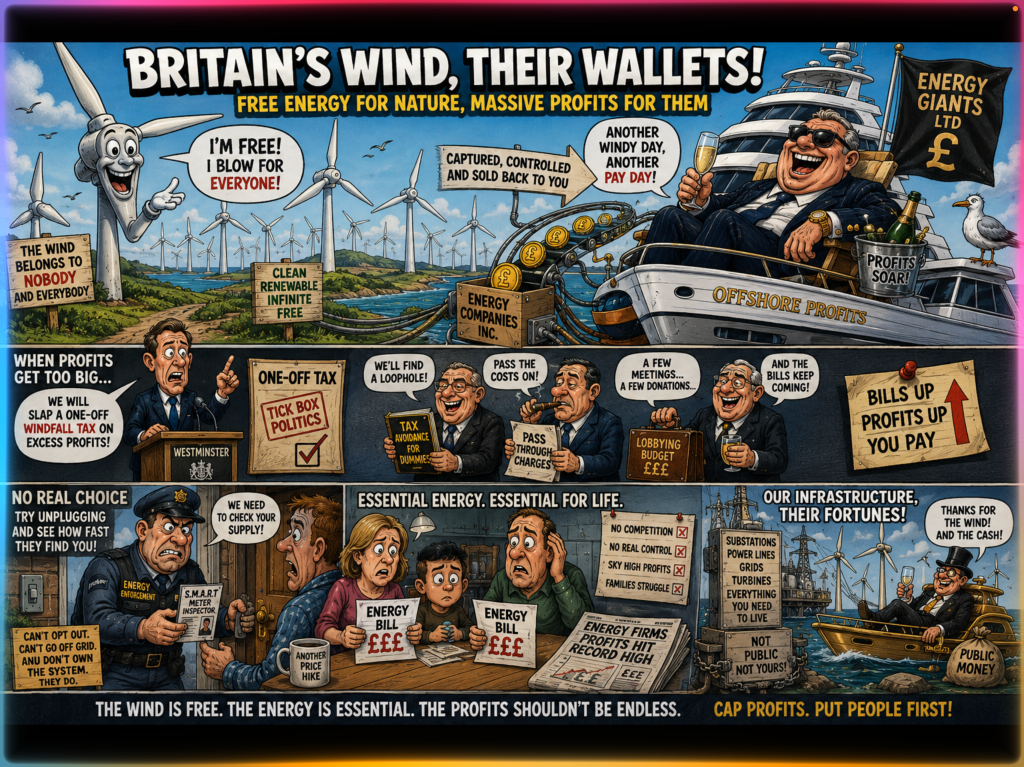
⚡🛥️The politicians tell us they’re going after “excessive profits” with one-off taxes. The energy companies tell us they’re investing in the future. Meanwhile, ordinary families stare at their bills wondering how something generated by the wind blowing across Britain’s coastline can cost as much as a luxury holiday. 🌬️💷
🏴☠️The Great Energy Gold Rush: Our Wind, Their Fortune
⚓💰Let’s get this straight.
The wind belongs to nobody.
The rain belongs to nobody.
The sun belongs to nobody.
Nature sends the bill to absolutely no one.
Yet somehow, by the time that free wind has spun a turbine and reached your kettle, half the country feels like it’s funding a billionaire’s yacht upgrade. 🚤💎
Every few months politicians emerge from Westminster looking shocked—absolutely shocked—that energy firms have made eye-watering profits. Then comes the ritual performance.
“We’ll impose a windfall tax!” they cry.
The public applauds.
The companies shrug.
The lawyers sharpen their pencils.
And somehow the bills keep arriving. 📬⚡
The truth is that energy isn’t like choosing between two coffee shops or deciding which supermarket sells the cheapest beans. You can’t simply tell the national grid to jog on and plug your house into a passing cloud.
Try disconnecting completely and you’ll quickly discover just how dependent modern life is on a system controlled by giant corporations, regulators, and politicians all pointing fingers at each other while your direct debit quietly increases. 🎯
The real absurdity is wind power itself.
Politicians proudly tell us Britain is becoming a renewable energy superpower. Fantastic news. The wind is free. The fuel costs nothing. Mother Nature hasn’t yet figured out how to send invoices.
So naturally the public assumes prices should eventually fall.
Instead, every announcement about cheap renewable energy somehow arrives alongside another explanation of why bills remain sky-high. 🤔
It’s a remarkable business model.
Imagine owning a field where gold nuggets fell from the sky every day, then charging the public ever-increasing amounts to admire your efficiency in collecting them.
That, many people would argue, is what modern energy policy feels like.
And whenever profits become politically embarrassing, politicians suddenly discover outrage they somehow misplaced while approving the system that created those profits in the first place. 🎭
One side blames the companies.
The companies blame global markets.
The regulators blame circumstances.
The politicians blame each other.
And the public gets the bill.
Again.
🔥Challenges🔥
If energy is as essential as water, roads, hospitals and national security, should profit margins be capped?
Should key parts of Britain’s energy infrastructure be publicly owned?
Or are politicians using energy company profits as a convenient distraction from years of failed policy?
Drop your thoughts in the blog comments. 💬⚡
👇 Like, comment and share if you’re tired of hearing that “free” wind somehow results in expensive electricity.
🏆 The sharpest comments and hottest takes will be featured in the next issue of the magazine.


 Chameleon Magazine
Leave a comment