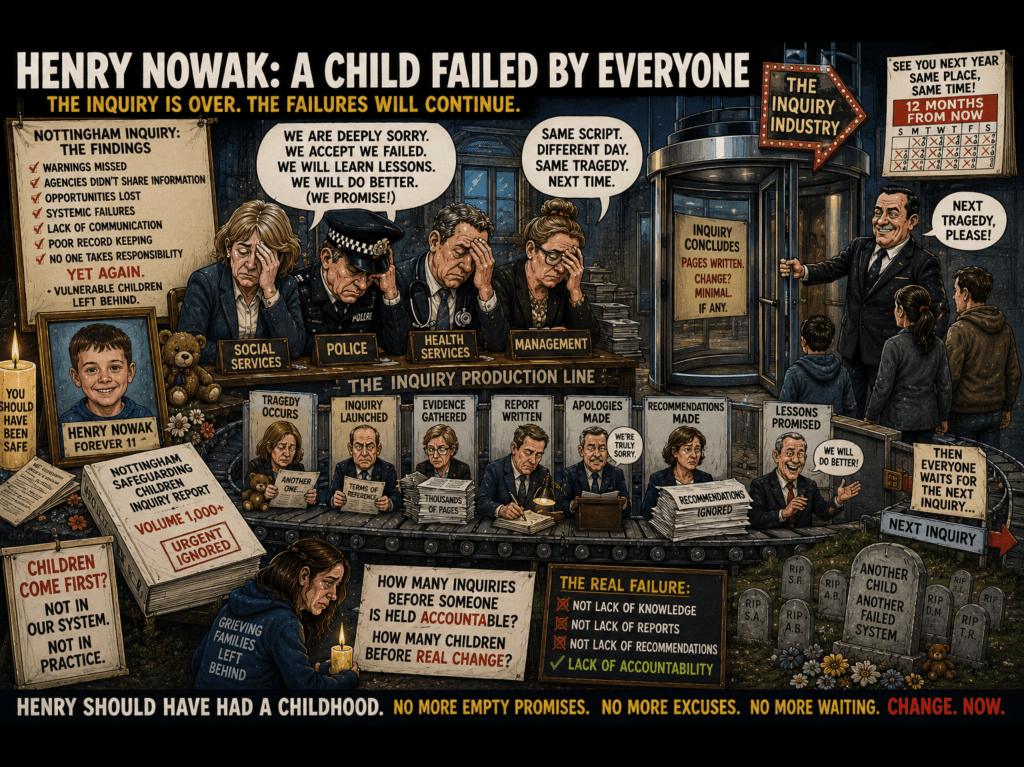
💔As the memory of Henry Nowak fades from the headlines and the Nottingham inquiry reaches its conclusions, the findings appear painfully familiar.
Warnings missed.
Agencies not communicating.
Opportunities lost.
Families failed.
And after thousands of pages, countless meetings, and solemn statements, the public is left asking the same question they ask after every major tragedy:
What will actually change? 🤔
🚨The National Inquiry Production Line
📋The script rarely changes.
A terrible tragedy occurs.
The public demands answers.
An inquiry is launched.
Years pass.
Evidence is gathered.
Officials apologise.
Failures are identified.
Recommendations are made.
Everyone promises lessons have been learned.
Then everyone waits for the next inquiry. 🔄
The most heartbreaking part is that many of the findings are rarely new.
Communication failures.
Information not shared.
Warning signs overlooked.
Responsibility passed from one agency to another like a bureaucratic game of hot potato. 🥔🔥
Police blame resources.
Social services blame workloads.
Health services blame pressures.
Management blames systems.
The systems blame complexity.
And somewhere in the middle sits a grieving family wondering how so many professionals could miss what now appears obvious. 💔
The public are repeatedly told that safeguarding is the highest priority.
That children come first.
That vulnerable people will be protected.
Yet after every inquiry, the same words seem to reappear.
“Systemic failures.”
“Missed opportunities.”
“Lack of coordination.”
“Lessons must be learned.”
At some point, people stop asking whether lessons have been identified and start asking whether anyone is actually sitting the exam. 📝
Because if the same recommendations appear inquiry after inquiry, decade after decade, perhaps the issue isn’t a lack of knowledge.
Perhaps it’s a lack of accountability.
🔥Challenges🔥
How many inquiries can identify the same failures before the public loses faith completely?
Should senior officials face consequences when repeated safeguarding failures occur under their watch?
Or have public inquiries become exercises in managing outrage rather than delivering lasting change?
Drop your thoughts in the blog comments. 💬🕯️
👇 Like, comment and share if you believe families deserve more than apologies after tragedy.
🏆 The most thoughtful comments and strongest observations will be featured in the next issue of the magazine.


 Chameleon Magazine
Leave a comment