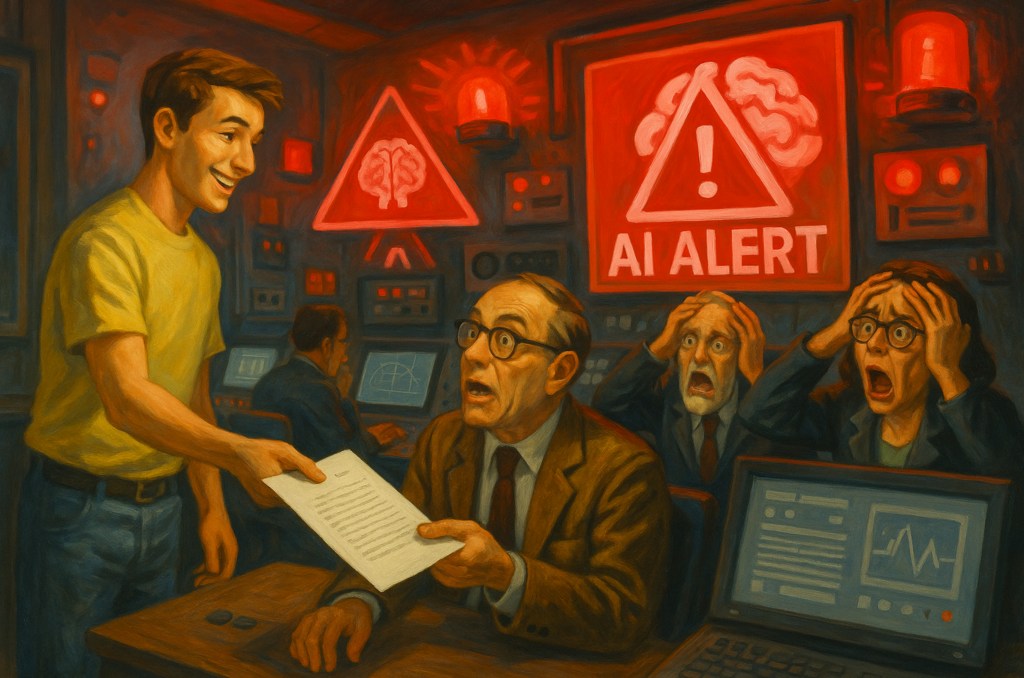
Apparently, writing well now counts as suspicious behavior. Welcome to academia’s new panic room, where polished thought is punishable by algorithmic suspicion—and self-doubt gets you an A.
🎓 “Too Smart to Be Human?” — Welcome to the Academic Circus
Once upon a time, the dream was to teach students how to think, argue, and express themselves clearly. But now? If you dazzle with a well-crafted essay, don’t be shocked if your teacher squints and mutters, “Hmm… this feels a bit too articulate. Must be ChatGPT.”
Yes, dear students, clarity is now a red flag. Eloquence is evidence. Good grammar? Guilty.
And what’s worse? Clumsy, chaotic writing—the kind where sentences trip over themselves like drunks at a spelling bee—is being hailed as more “authentic.”
Because nothing screams genuine human effort like a paragraph that reads like a dying text message.
We’ve officially entered an academic Twilight Zone where struggle is virtue, confusion is credibility, and excellence is… AI.
🤖 The Better You Write, The More You’re Suspect
So let’s recap the new educational vibe:
- Sound smart = you’re cheating
- Sound unsure = you’re honest
- Sound average = gold star
This isn’t pedagogy. This is performance art. Students aren’t learning to express complex thought—they’re learning to stage-manage just enough imperfection to look “real.” Sprinkle in some awkward phrasing. Add a hesitant conclusion. Maybe throw in a typo, just to be safe.
All to pass the vibe check of a paranoid professor.
Here’s the kicker: even this messy voice can now be faked by AI. So we’re not just chasing our tails—we’re giving the tail to the chatbot and asking it to shake convincingly.
📉 The “Authenticity” Spiral — And Why It’s a Trap
The most depressing part? We’ve stopped teaching kids to write well. We’re teaching them to write believably. Not like thinkers, but like low-stakes impostors who carefully calibrate their sentences to avoid suspicion.
It’s not about ideas. It’s about optics.
We’ve turned English class into a reverse Turing Test: prove you’re human by being a little bad at it.
Why strive for excellence when sounding like a 2005 Tumblr post gets you more academic trust than a polished argument? Why build skills when your best work makes you look like a fraud?
This isn’t education. It’s insecurity in a cap and gown.
🧩 Here’s What Education Should Be Doing Instead
If schools truly want to prepare students for a world filled with AI, then here’s a radical idea: teach them to think beyond it.
- Show them how AI writes—and where it fails.
- Push them to go deeper, argue harder, risk being original.
- Make students explain themselves in conversation, in defense, in reflection.
- Praise clarity, not clumsiness.
- Encourage bold thought, not breadcrumb trails of uncertainty.
Stop grading based on vibes and start valuing thought. Because real learning doesn’t come from mimicking flaws—it comes from mastering meaning.
Authenticity isn’t found in typos. It’s found in why someone says what they say—and how bravely they say it.
Challenges
Do we really want a generation of thinkers afraid to sound smart?
Should we reward mediocrity just because it’s less intimidating than intelligence?
Are we grading student voices—or just gut-checking our own trust issues?
Get mad. Get sarcastic. Get loud in the blog comments.
👇 Drop your thoughts, your rants, or your most fire emoji-loaded takes below. Share this with someone who still thinks a typo means “truth.”
The best comments will be featured in the next issue of the magazine.


 Chameleon Magazine
Leave a comment