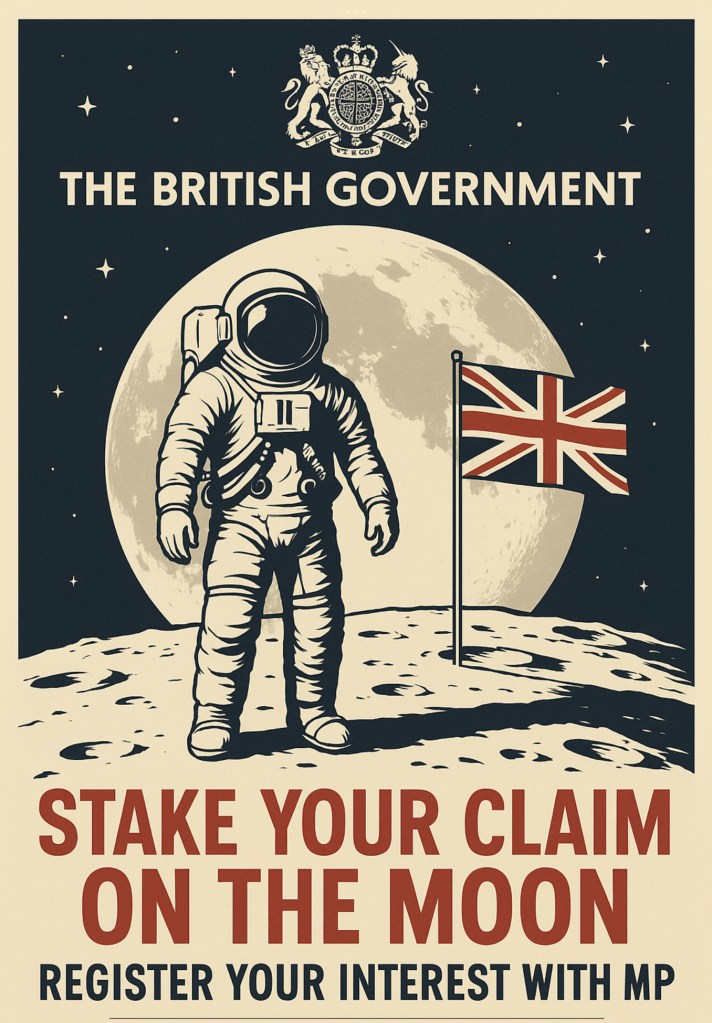
GOVERNMENT EYES THE MOON AS “THE WILD WEST OF THE UNIVERSE”
It might sound ludicrous—another headline ripped from a satire site or a minister’s half-baked LinkedIn post—but according to multiple Whitehall insiders, the British government is seriously exploring the idea of colonising the Moon.
Yes, the actual Moon.
Early documents suggest officials aren’t quite ready to plant the Union Jack in lunar soil just yet—but they are quietly putting out feelers to gauge public response to a scheme that, if pursued, would make the UK the first nation to formally claim and settle a portion of the Moon’s surface.
Moon Plots and Mineral Riches
According to leaked planning documents from the Ministry of Interplanetary Prospects and Fracking, the government is reviewing a long-term initiative to establish a permanent British presence on the Moon—with the express aim of claiming lunar territory and securing access to vast mineral resources, including helium-3, yttrium, and other rare earth elements critical to advanced technologies.
Legal experts within the department have reportedly confirmed that international lunar law currently allows territorial rights to be asserted—but only once humans have physically occupied the land in question. As such, ministers are exploring a pioneering programme that would send British citizens to live in modular, human-rated habitats on the Moon for a minimum of one year.
The proposed settlement site, already nicknamed “New Kent”, is located near the Moon’s equatorial region, close to the Sea of Tranquility—an area chosen for its stable temperatures and possible sub-surface ice deposits.
The Wild West of the Universe
Internal briefings describe the Moon as “the Wild West of the universe,” an unregulated zone of untapped value where national advantage will belong to those who act, not those who negotiate.
“This is a geopolitical opportunity,” reads one memo. “The Moon will not wait. Whoever gets there first, stays there first.”
The government plans to construct self-sustaining, pressurised habitats capable of supporting scientific research, automated mining, and basic life support for early settlers. If deployed successfully, these outposts could serve as the foundation for permanent British lunar infrastructure—and, eventually, interplanetary trade routes.
Public Interest Phase Begins
At this stage, the plan remains in public consultation mode, with no formal recruitment under way. However, government sources confirm that the current priority is to measure national appetite for long-term off-world commitment.
To that end, British citizens are now being encouraged to register their interest by contacting their local MP. Interested individuals should include their name, postcode, and a brief personal statement explaining why they believe they would make a suitable Moon resident.
“This is a serious national venture,” said Dr. Imogen Fairhurst, senior advisor to the Department of Off-World Strategy. “It requires resilience, intellect, and a willingness to shape history. We’re not just building a moonbase—we’re defining a legacy.”
MPs will be expected to report anonymised data on public interest to the Cabinet Office by the end of the quarter.
Ownership Model: Stake in the Stars
Though the land will remain under British jurisdiction, each approved settler will be entitled to a 20% share in the value of any minerals extracted from the lunar plot they occupy. The rest would be held in trust by the Crown Lunar Authority (a new body reportedly in early planning stages).
Economists say even small discoveries could be transformative. “If helium-3 becomes viable for fusion energy, early stakeholders could see generational wealth from their year on the Moon,” said Rupert Cleves, an aerospace investment advisor. “It’s high risk, yes—but potentially the most high-reward move Britain has made in 100 years.”
Critics Warn of ‘Cosmic Colonialism’
Not everyone is onboard. Opposition leaders and climate advocates have raised concerns about the ethics of lunar extraction and off-world ownership.
Green Party leader Fern Wiggins called the plan “cosmic colonialism” and warned of “repeating Earth’s worst instincts with even more expensive mistakes.”
Others questioned the government’s priorities. “Maybe fix the NHS before launching a housing scheme in the sky,” one MP quipped anonymously.
Still, ministers seem quietly confident the public will respond with enthusiasm.
“This isn’t about escaping Earth,” said one Whitehall aide. “It’s about securing Britain’s place in the next chapter of human civilisation. If we don’t do it, someone else will—and they might not give us a seat at the table.”
INTERESTED IN BECOMING ONE OF BRITAIN’S FIRST MOON RESIDENTS?
Contact your local MP and quote the Moon Residency Pilot Programme.
Include your name, postcode, and a short statement of interest.
Further announcements are expected soon via:
http://www.ownamoonplot.gov.uk (site under construction)


 Chameleon Magazine
Leave a comment