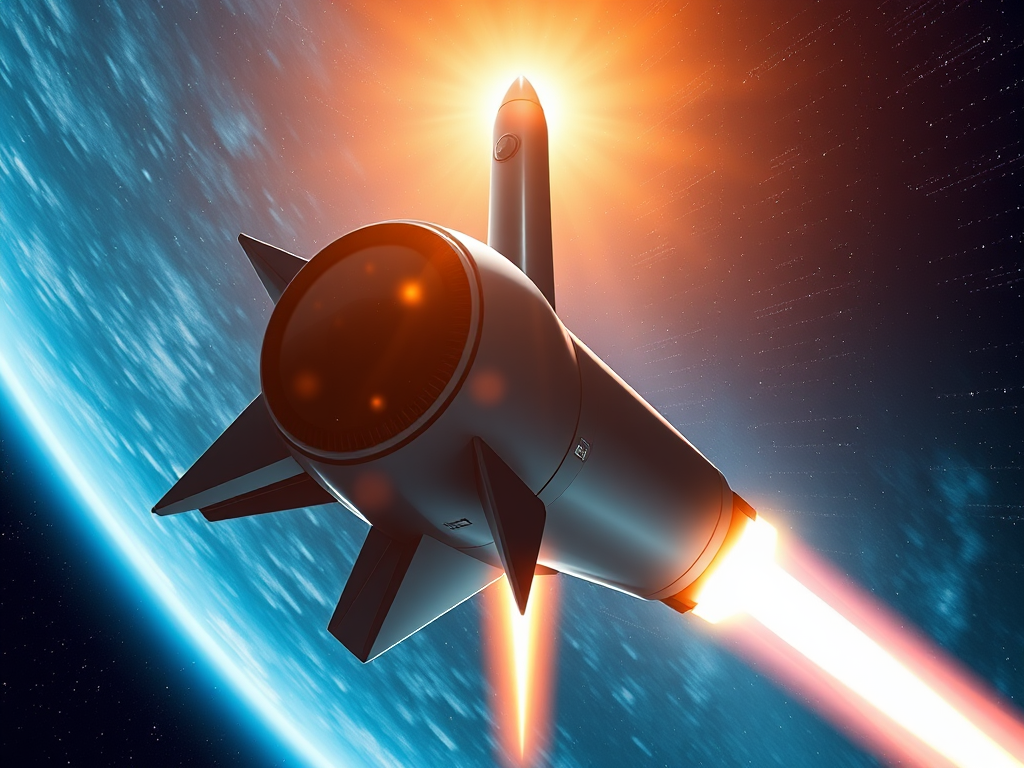
“Sunbird Rises: UK Fusion Rocket Startup Skyrockets After Musk Tweet Sends Markets Into Orbit”
By: Evelyn Hart | Science & Innovation Correspondent
They were the outsiders — a quiet team of engineers and physicists based in Oxfordshire, tinkering with nuclear fusion while the world was distracted by AI and electric cars.
Now they’re the most talked-about company on Earth.
This week, Pulsar Fusion, a previously under-the-radar British aerospace startup, unveiled the Sunbird — a nuclear fusion-powered rocket engine capable, in theory, of reaching speeds of 329,000 mph. That’s fast enough to cut the journey to Mars from 7 months to 30 days.
The technology, known as a Direct Fusion Drive (DFD), mimics the energy of the Sun, creating controlled plasma reactions within a compact propulsion unit. If successful, it would eliminate the need for chemical rockets entirely.
But it wasn’t just the science that ignited global interest.
“Fusion + rockets = 🚀☀️” — Elon Musk
On June 15, following a viral video of the Sunbird plasma test, Elon Musk liked and retweeted the clip with a short, explosive comment:
“Fusion + rockets = 🚀☀️. The future isn’t coming. It’s accelerating.”
That tweet, just nine words long, catapulted Pulsar Fusion’s valuation from £420 million to over £3.4 billion in under 72 hours. Founders Dr. James Lambert and co-engineer Anika Shah became overnight multimillionaires, with early shares now worth more than £25 million each.
The market frenzy was further fueled by rumors Musk is preparing a strategic investment or potential acquisition, possibly integrating Pulsar’s fusion drive with SpaceX’s long-term plans for deep-space exploration and interstellar cargo delivery.
One investor called it:
“The most exciting propulsion development since the moon landing. And this time, it’s British.”
What’s Next?
Pulsar Fusion has announced plans for a 2027 orbital test, supported by a growing consortium of private funders, with additional interest from the European Space Agency and unnamed commercial defense partners.
Their roadmap includes:
• Mars cargo delivery by 2029
• Autonomous asteroid mining by 2032
• Human-rated interplanetary propulsion by mid-2030s
As of this morning, representatives from NASA, ESA, and SpaceX have all reportedly scheduled meetings with the Pulsar team in London.
A British Space Renaissance?
Whether the Sunbird ultimately delivers on its promise remains to be seen. But today, for the first time in decades, the UK is at the forefront of space innovation — not by playing catch-up, but by leading the charge.
As Dr. Lambert told reporters outside their modest HQ:
“We’ve always looked to the stars. Now we might actually get there faster than anyone thought possible.”
[VIDEO AVAILABLE]: The Sunbird Plasma Test – Watch the Reactor That Caught Elon Musk’s Attention
🎥 [Click to watch: 0:46]


 Chameleon Magazine
Leave a comment