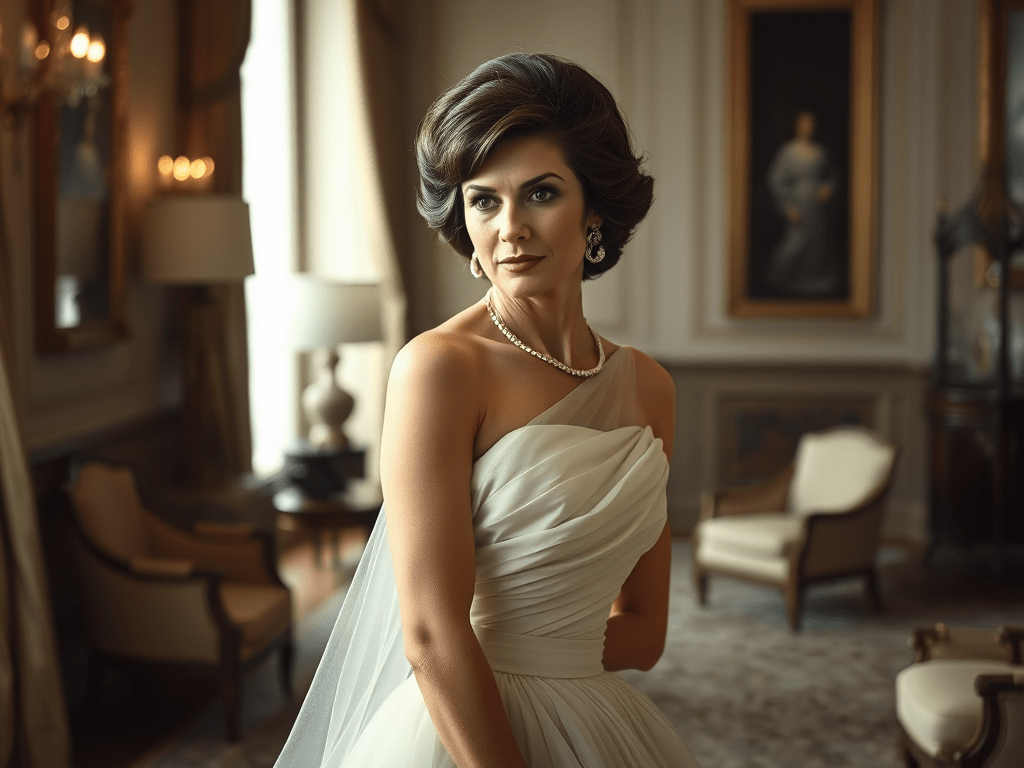
She was the queen of style, grief, and calculated escape. Jacqueline Kennedy Onassis wasn’t just the First Lady of fashion—she was the first lady of emotional chess, media manipulation, and designer-strength survival instincts. Forget the sanitized PBS tributes and Etsy prints of her quotes—Jackie O didn’t just endure history, she re-edited it.
💔 From First Lady to Fortress: The Real Housewife of American Tragedy
Let’s drop the mythology and cue the real drama: Jacqueline Lee Bouvier didn’t marry into Camelot—she branded it. A photogenic power couple? Please. JFK brought the votes, Jackie brought the aesthetic. From her eerily calm tour of the White House to her Edith Piaf aura, she wasn’t America’s sweetheart—she was its silent PR director.
But JFK’s loyalty had the lifespan of a cigarette in the Oval Office. Marilyn Monroe wasn’t just the side act—she was practically on the playbill. Jackie, meanwhile, played the long game in couture armor, wielding silence like a samurai sword. You think she didn’t know? She knew. She calculated.
Then came Dallas—blood, brains, and Chanel boucle. The fact that Jackie didn’t dissolve into the floor of that Lincoln Continental is still one of the most disturbing flexes in modern history. And when she orchestrated JFK’s funeral like a Broadway tragedy, it wasn’t just grief—it was production. Jackie wasn’t just a widow; she was a director of legacy.
And when Bobby went down in ‘68, Jackie went full Cold War-era defector. Enter: Aristotle Onassis. Rich. Rude. Reptilian. If JFK was Camelot, Onassis was capitalism with a tan. But Jackie didn’t want love—she wanted exit. A billionaire bunker. A yacht with Wi-Fi and zero assassination risk.
🛳️ Love, Loss, and a Greek Exit Strategy
Let’s not sugarcoat it: Jackie married the world’s richest curmudgeon like someone installing a steel door after a home invasion. America gasped. Historians clutched pearls. But Jackie? She secured the bag and the bodyguards. It wasn’t betrayal—it was a reboot. She didn’t walk away from Camelot. She sailed away with an emergency exit plan and better shoes.
Post-Onassis, she ghosted the spotlight harder than your ex after tax season. A New York editor? That was her final magic trick. After decades of being gazed upon, she finally got to look—at manuscripts, at books, at herself. Jackie O was finally Jackie, editor-in-chief of her own damn life.
👁️ The Devil Wears Oleg Cassini
So, what’s the legacy here? That grace can be weaponized. That elegance can be engineered. That the most powerful position a woman can hold isn’t always behind a podium—but beside, behind, or beyond the men who dominate it.
Jackie didn’t break. She bent the narrative like origami. She didn’t cry on cue. She redrew the script. She didn’t tell you what she felt—she dressed it, directed it, and disappeared before you could ask.
Want truth? Jackie gave us something better: legend. 👑📸
🔥 Challenges
Did Jackie O outsmart a system designed to silence her—or just buy time on someone else’s yacht? Was her silence a statement of strength or strategic PR? And does any of it matter if history still calls her “style icon” instead of survivor?
💬 Drop your thoughts in the blog comments—not just Facebook. Let’s get real, let’s get messy, and let’s stop pretending pink suits come without bloodstains.
👇 Like. Share. Comment. Put your stamp on Jackie’s myth.
📝 The best takes will be featured in the next issue of the magazine. Get sharp. Get loud.


 Chameleon Magazine
Leave a comment