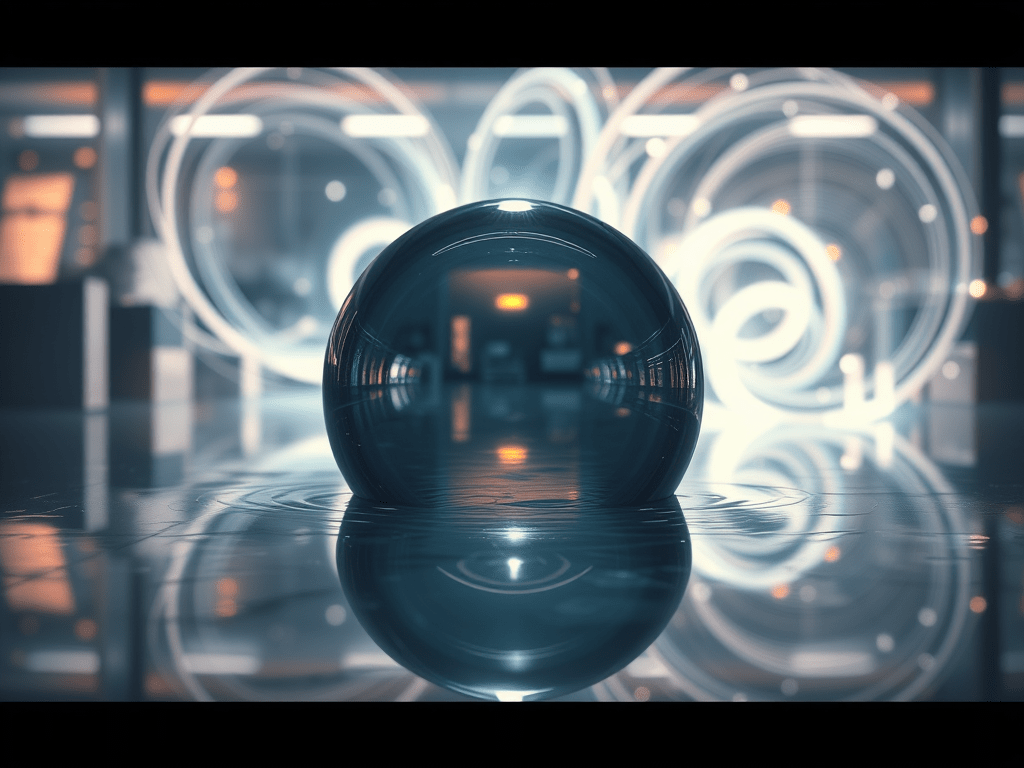
A meditation on measurement, meaning, and the mirrors inside our minds.
🎭 Schrödinger’s Mirror: Where Physics Meets the Psyche
Picture this: You’re watching yourself think. You, the thinker, observing your own thoughts like clouds drifting across the sky. Now imagine doing this while standing inside a lab, staring at a quantum particle through a device that may—or may not—cause that particle to “decide” where it is.
Welcome to the Observer’s Paradox, where reality itself seems allergic to being seen.
In quantum mechanics, the observer isn’t just a passive onlooker. Observation affects outcome. A particle behaves like a wave until measured, at which point it collapses into a definite state. This much we’re told. But zoom out—and in—and a deeper question arises: is the universe waiting for your gaze to settle into form? Or is your gaze simply catching what was always there?
What happens when the observed is your own mind?
🧠 Mind as Microscope, Self as Superposition
The brain is a predictive machine, yes. But it’s also an interpretive dreamer. When we become aware of a thought or a feeling, we seem to “collapse” its meaning into something we can name. But prior to that, in the liminal spaces of attention, isn’t every emotion a waveform? Every impulse a cloud of probability?
You are both the instrument and the anomaly. Just as a quantum particle “chooses” when observed, so too does your selfhood flicker between identities. The person you were five minutes ago is not the one reading this sentence.
If physics teaches us that reality is not fixed until measured, then consciousness teaches us that the self is not fixed until narrated.
🪞 The Dreamer in the Machine
Let’s toy with a hypothesis: that the act of observing your life—narrating it, retelling it, choosing how to remember it—is the very act of collapsing your reality. Are you simply reporting the facts of your past? Or shaping them into a waveform that fits your chosen frequency?
In other words: is memory a story? Is perception a bias? Is the observer ever truly neutral?
✨ The Observer as Creator
Mystics have long intuited what physicists are only beginning to quantify—that awareness is not passive. It’s an act of creative tension. Whether through mindfulness meditation or Heisenberg’s equations, we keep arriving at the same unsettling insight: reality responds to being watched.
And if so, what are the ethical implications of attention? What do we owe the world we gaze upon?
If we collapse reality into form simply by the act of seeing—what responsibility comes with the gaze?
What possibilities come with it?
Thinking about this just made my brain hurt. 🫠🧠


 Chameleon Magazine
Leave a comment