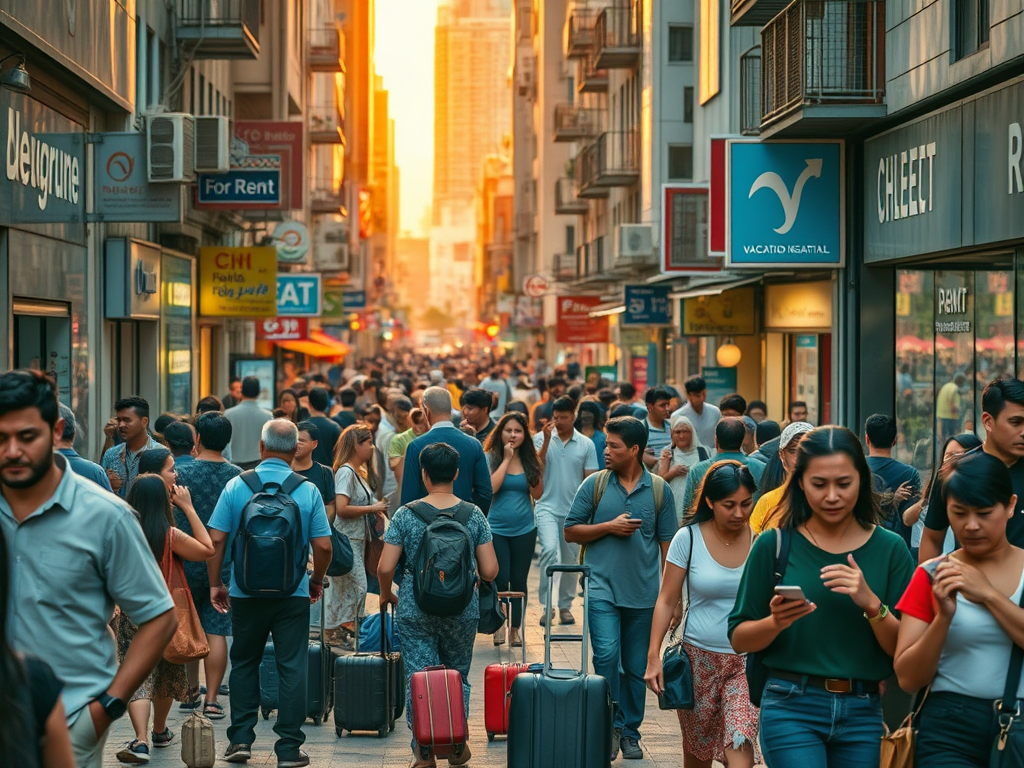
There’s a new kind of urban drama unfolding—one not set in far-flung dystopias but on your very own street.
Global cities are being overrun—not by armies, not by aliens, but by travelers, transplants, and temporary tenants. From Mexico City to Lisbon, Tokyo to Toronto, the world’s most desirable places are groaning under the weight of their own popularity. The sidewalks are packed, the rents are surging, and the locals? They’re trapped in a high-stakes version of musical chairs… where the music never stops and half the seats are now on Airbnb.
🏘️ Stuck at Home While Others Play House
Here’s the kicker: while digital nomads bounce from city to city with their curated travel reels and minimalist luggage, millions of young locals can’t even afford to move out of their parents’ homes.
The math is brutal:
- Rents have outpaced wages.
- Starter homes are rare unicorns.
- Every third apartment seems to have transformed into an Airbnb with “boho charm” and a $300-a-night price tag.
So while visitors live out their Eat, Pray, Wi-Fi fantasies, the people who actually grew up there are stuck sharing a bathroom with their younger siblings, refreshing Zillow in despair, or applying for their fifth job just to stay in the same zip code.
This isn’t just a housing crisis. It’s a cultural eviction.
✈️ The Age of Freeloading Nomads
The rise of the remote workforce was supposed to democratize freedom. But let’s be honest: it mostly created a glossy, upper-middle-class mobility bubble. The people who can move, do. And the people who can’t, watch their cities change around them without leaving the block.
Those foreign laptops you see in the local café? They aren’t contributing much beyond the cost of a cold brew and the occasional Instagram tag.
🚦When The World Becomes a Walk-In Closet
If the world once felt like a big place, it now feels like a very cramped open house. Everyone’s peeking in, poking around, seeing if it suits them.
But this isn’t just about travel. It’s about a deeper imbalance:
- Too many people with mobility, too few places with sustainability.
- Too many listings, not enough homes.
- Too many lifestyles, not enough shared life.
Cities weren’t designed to be short-term experiences. They were built for community, continuity, and contribution. But when half your neighbors are checking out next Thursday, how do you build anything long-term?
🔄 The Illusion of Movement
There’s a hard truth in all this: even those who move often aren’t escaping anything—they’re just shifting the problem. Traffic, cost, stress, and loneliness don’t disappear in a new timezone. They just arrive later… in a different language.
Meanwhile, the people who don’t move are left picking up the pieces of a place that no longer feels like theirs.
🧨 Final Thought: This Isn’t a Travel Story—It’s a Home Invasion
This isn’t about adventure. It’s about access. About the unfairness of a system that lets some people zip between cities like postcards, while others can’t even afford a permanent address in their hometown.
We’re living in an era where the freedom to move is colliding with the right to stay put. And it’s getting ugly.
🧠 Your Turn
Are you one of the stuck or the moving? Have you seen your city transform into something unrecognizable?


 Chameleon Magazine
Leave a comment